Perseverance: Writing, revising over 30 years leads to published essay

Vintage postcard: The beach at Oceanside, Calif., from “Views Along the Coast Route between Los Angeles and San Diego.”

Good News: The Spectacle publishes “Scorpion Diary”

My personal essay “Scorpion Diary” has been published by The Spectacle, a literary magazine based at Washington University in St. Louis.

“Scorpion Diary” started as an outline of a boxing-type battle scribbled on napkins at a pizza-by-the-slice shop in 1992. The first drafts focused on the woman versus nature conflict, along the lines of, “Whoa, I lived with scorpions.”

Based on paid feedback from a Tahoma Review editor, revisions incorporated more “woman versus nurture” elements, namely the lasting effects of my mother’s alcoholism. Although I had been researching and drafting pieces about women alcoholics for years, Mom had a rock-wall silent treatment. I knew she wouldn’t understand my need to examine our lives in writing, let alone publish what I’d written. After she died, I restarted my work on this and several related projects.

NOTE: Tahoma Review, Craft, and other literary magazines offer paid feedback and critique options. Prices start at a few extra dollars for the “feedback option” on your submission, which yields a paragraph from a magazine editor. Projects that could benefit from in-depth critiques may cost $50 or more (much, much more). As always, select reputable organizations and editors who work with your type of writing. Beware of editors offering promises of greatness if only you’d send them more money.

Given the years I spent in stealth research mode, especially regarding women alcoholics, my source list for “Scorpion Diary” was long. Present-day websites, such as the “Alcohol Self-Assessment Test” from the National Council on Alcoholism and Drug Dependence, continue to prove helpful given the effects of substance abuse on families and children. My oldest source was a doctoral dissertation on Arizona scorpions from 1939.  

The college-instructor frame for “Scorpion Diary” came from chats with two students during a memorable pre-pandemic semester. One student felt she had to choose between supporting her alcoholic mother or pursuing her own goals to get an education and career. Another student was in crisis about how to get through the semester while keeping his family housed. I recognized the parental roles both students took on, complete with the burdens of guilt and Sisyphean responsibilities.

A major revision took “Scorpion Diary” (as well as “Handwashing Dishes,” which was published by Southeast Review) into second-person (you) point of view. Second-person POV helped me navigate glitchy passages that wanted to shift between first-person insights and third-person reportage. Second person offered a balance between emotional distance and experiential immediacy that conveyed more than I ever thought I could back when I was writing on those pizza-place napkins.

Readings that inspired my work in second person continue to include, Cherry, a memoir by Mary Karr, as well as chapters from The Rose Metal Press Field Guide to Writing Flash Nonfiction that focus on writing in second-person.

On Becoming an Adjunct Instructor: 3 sources for further reading

Vintage postcard: Driveway in Busch’s Sunken Gardens, Pasadena, Calif.

Good News: Inside Higher Ed publishes career advice for adjunct faculty

My cautionary essay, “Advice to a Friend on Becoming an Adjunct,” has been published by Inside Higher Education.

The idea and structure for the essay came from reading Benjamin Franklin’s “Advice to a Friend on Choosing a Mistress,” which dates back to 1745. I saw similarities between Franklin’s words and present-day discussions of adjunct faculty. You may remember one of the Franklin’s oft-quoted lines, “And as in the dark all cats are grey…”

DEFINITION: Adjunct faculty may be called lecturers, faculty associates, or similar titles. Adjunct or contingent faculty are contracted to teach one or more university courses each semester. While they are not on the tenure track, adjunct faculty hold advanced degrees in their subject areas, and teaching may be their full-time job. 

I began drafting this essay after receiving an adjunct teaching contract with a per-course pay rate so low that it was similar to my first teaching contract in 2000.

Regrets surged at having stayed with adjunct teaching and its attendant fears of losing full-time work (and health insurance) every fall and spring. Looking back, I would have advised myself to exit the academic treadmill of year to year or semester to semester contracts and re-enter the ranks of higher ed. classified or professional staff—jobs that offer more stable schedules, competitive incomes, and maybe even raises.

In any case, the Inside Higher Ed essay offers advice I wish someone had told me (or that I had listened to). If you’re interested in some of my sources, I’d like to share the following:

Sources (partial list)

The Adjunct Underclass: How America’s Colleges Betrayed Their Faculty, Their Students, and Their Mission, University of Chicago Press book

The Adjunct Underclass: How America’s Colleges Betrayed Their Faculty, Their Students, and Their Mission by Herb Childress, a former dean at the Boston Architectural College, was published by the Chicago University Press in 2019. The book offers “Recommendations for Survival in the Current Climate,” including that grad students should consult the National Research Council’s assessment of doctoral programs. “Be cautious about applying to any school not in the top 10 percent of its discipline,” writes Childress. “Lots of doctoral programs can give you a wonderful intellectual experience; only a few of the are likely to give you a chance in the [higher ed.] labor market.” To further gauge one’s prospects for a career in academia, Childress’s self-test, “The Academic Career Calibration Protocol,” may feel like an ice-water dunk.

Who Are the Part-Time Faculty: There’s No Such Thing as a Typical Part-timer,” American Association of University Professors article

Who Are the Part-Time Faculty: There’s No Such Thing as a Typical Part-timer” by James Monks, an economics professor at the University of Richmond, Va., was published in AAUP’s Academe in July-August 2009. The article includes a plethora of economic, demographic, and related data about contingent faculty. “[P]art-time non-tenure track faculty earn between 22 and 40 percent less than tenure track assistant professors on an hourly basis,” writes Monk in citing his earlier article, “The Relative Earnings of Contingent Faculty in Higher Education,” which was published by the Journal of Labor Research in 2007. Monks’s earning percentages seem high, based on my years in the adjunct world at Wisconsin and Arizona universities.  

Professional Identity in a Contingent-Labor Profession: Expertise, Autonomy, Community in Composition TeachingWriting Program Administration article

Professional Identity in a Contingent-Labor Profession: Expertise, Autonomy, Community in Composition Teaching” by Ann M. Penrose, an English professor at North Carolina State University, Raleigh, was published in Writing Program Administration in 2012. Among Penrose’s points is a discussion of how a profession is defined to include growth and development. She asks whether contingent instructors are members of a profession/discipline given their often-narrow opportunities for growth. “But under the conditions of contingent employment, ‘professional development’ can easily be interpreted as a euphemism for brainwashing or remediation….,” writes Penrose. Brainwashing is a strong word, but my professional development opportunities related almost solely to practical concerns, such as university technology adaptations, curriculum changes, or course development. “Under this interpretation,” Penrose writes, “professional development activities are intended to regulate and regularize and thus present a clear challenge to an experienced faculty member’s autonomy and professional identity.”

Other Sources

Publications regularly covering issues concerning adjunct university instructors, such as unionization efforts, include:

Related post

Thinking about a college teaching gig?

Bookshelf: Elizabeth Berg’s Escaping into the Open offers a plethora of writing prompts

Vintage postcard: Eagle River and Dam, Copper Country, Michigan.

Writing Prompts. Love them? Hate them?

Most writers can point to a project that started or developed with a prompt.

Prompts prove useful when casting about for fresh writing projects. After all that prompt-based writing, however, steel yourself for slogging through the rubble to find gems.  

Revision work may be where prompt-based writing shines. Approach prompts with an ongoing project in mind. Seek material that deepens your text without sending the project on tangents. The results can be satisfying.

Escaping into the Open

Among the prompts worth visiting (or revisiting) are those in novelist Elizabeth Berg’s Escaping into the Open: The Art of True Writing. The book, which is nearing its 25th anniversary, includes a full chapter of prompts that shows “thinking less and writing more can become a very good habit.” While the book’s publishing industry advice is a bit dated, Berg’s encouragement and guidance on using details to bring writing alive continues to be timeless.    

Field trips

Berg recommends field trips or rather “plunking yourself down in a different environment” and writing about “everything you see and hear and feel, if only to make a list of sensations.”

Documenting the people, as well as your senses, can yield characterizations, such as “nose-ringed teenagers” and “pastel-cardiganed grandmothers,” to replace stickier, clunkier lines.

In terms of setting, Berg recommends focusing on ambient sounds that “can help your readers visualize a place.” For example, tune into the sounds after a church’s prayer vigil or lunchtime at a local diner.

On field trips, seek the details, updated metaphors, and memories (yours or your characters) that give weight to your words. In doing so, run through your senses of sight, sound, smell, touch, and taste.

Speaking of taste and that field trip to a local diner, what would your character crave or try under duress? There’s a special place for food in both fiction and nonfiction writing, especially cuisine linked to a particular setting.

Red Flannel Hash

The opening paragraph of Pam Houston’s short story “The Best Girlfriend You Never Had,” from The Best American Short Stories 1999, does a lot of work and refers to a specific food:  

“A perfect day in the city always starts like this: my fiend Leo picks me up and we go to a breakfast place called Rick and Ann’s where they make red flannel hash out of beets and bacon, and then we cross the Bay Bridge to the gardens of the Palace of Fine Arts to sit in the wet grass and read poems out loud and talk about love.”

Red Flannel Hash? Beets?
Beyond Pam Houston’s story, I explored this new-to-me way to eat beets, one of nature’s so-called superfoods. I recommend this recipe from Taste of Home: https://www.tasteofhome.com/recipes/red-flannel-hash/ The Red Flannel Hash recipe, which includes vegetarian options, calls for corned beef, but I used four slices of bacon to match the description in Houston’s story.

To “prime the subconscious pump,” try some prompt-based drafting and take writing-focused field trips. Consider the following prompt from Berg’s book to get you started:

“Describe five completely different types of people placing their order for coffee with the same waitress. Describe these people in appearance, movement, and speech. If you like, also describe the waitress’s reaction to them.”

Manuscript drafts benefit from a rest

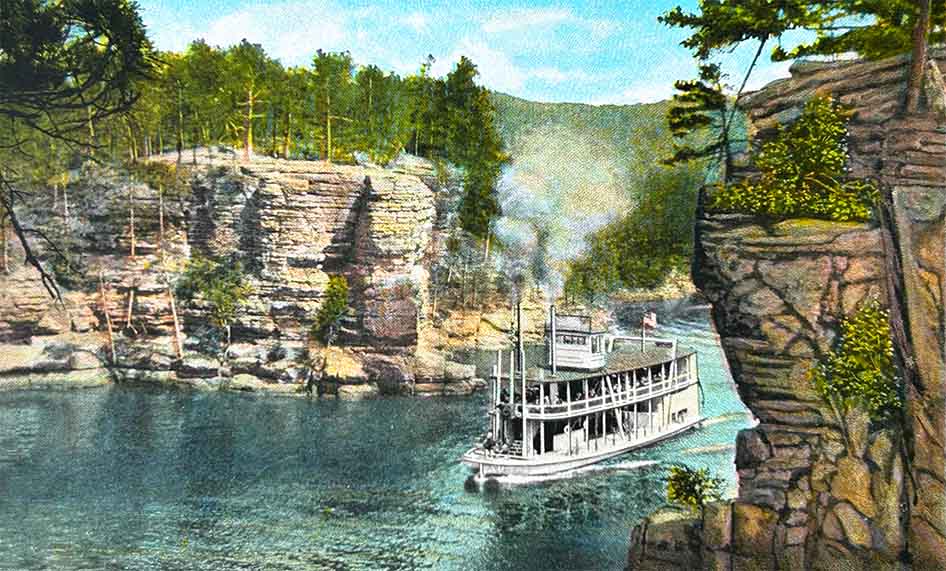
Vintage postcard: High Rock from Romance Cliff, Dells of the Wisconsin River.

Even fresh from summer vacation, taking a break from writing may be just what you need

Sometimes the best thing for your writing is taking a break from your writing. As such, I’ve built in a “rest” period for all non-deadline projects.

For example, after saving a revision, a project might seem good (or even great). Finished.

Resist the temptation to market the manuscript right away, because… When you read that same file a week or more later, any glitches, typos, or flat-out errors will pop.

Save yourself from the cringy rereading of a rejected manuscript and realizing exactly why it was rejected. You probably sent it out months ago, and now, given some time and distance, you can see the problem(s) the editors saw. To make matters worse, most markets won’t accept resubmissions of rejected work, so you’ve burned a market for that project.

A week to the wise

Even when a manuscript feels done, note in your calendar to check it a week from now. If you don’t need to revise when you reread the text next week, the project is probably ready to market. If you revise again, schedule a check another week out.

After a rest period, you’re more likely to approach your manuscript fresh. You see what a reader sees, not what you think you wrote. You’re more likely to hear the glitches or repetitions. You’ll see where content is missing or extraneous—things you thought you covered or cut. Similarly, you are likely to see where the text works well, repeats, or slows to a slog.

A month?

For larger projects or more significant revisions, a month’s rest may be useful. Take a month away to clear your mind of all assumptions. In the meantime, work on other projects, prep work, marketing plans, reading, and so on. You may stumble upon solutions to issues in your work-in-progress that require further revising, restructuring, expanding, or contracting.    

The trick with rest periods is not letting a break turn into abandonment, defeat, or worse. Keep going back, even to those projects that fight you.

Blog roll

See the following blogs/sites for other perspectives on writing breaks:

Recommended reading on the craft of fiction writing: ‘From Where You Dream’ by Robert Olen Butler

From Where You Dream: The Process of Writing Fiction by Robert Olen Butler is a book worth another look

‘Please get out of the habit of saying that you’ve got an idea for a short story. Art does not come from ideas. Art does not come from the mind. Art comes from the place where you dream. Art comes from your unconscious; it comes from the white-hot center of you.” —Robert Olen Butler, From Where You Dream

The best writing craft books transport you. You imagine you’re in a college seminar with an expert creative writing teacher. Unlike typical classrooms, however, these books allow you to work at your own pace.

Such expert teaching by Pulitzer Prize-winner Robert Olen Butler is captured in From Where You Dream: The Process of Writing Fiction, published by Grove Press in 2005.

Tapping into the unconscious, hence the word dream in the book’s title, is one of Butler’s main points. He offers insights into how and when to access your unconscious in the pursuit of art. Butler uses examples from his own, often messy, writing process to illustrate the yeoman work and perseverance required.

“You must … desire to create works of fiction that will endure, that reflect and articulate the deepest truth about the human condition,” Butler says in greeting his students. “I will take your aspirations seriously, and I will demand that you take them seriously.”

If your fiction is good, but not quite resonant or true, Butler’s insights and process tweaks may help you level up. The process won’t be simple or easy. However, the difference might be between creating fiction where you can pick almost any line and find something sensual, telling, and fresh (hint: Gabriel Garcia Marquez) versus writing that just gets the job done.  

For instance, to access the unconscious, Butler recommends journaling for 45 minutes to an hour, especially in the morning, as close to emerging from your dreams as possible. Similarly, journaling before sleep may also prime unconscious consideration.

“But here’s a certain kind of journal that might be useful to you: at the end of the day or beginning of the next day, return to some event of the day that evoked an emotion in you,” Butler says. “Record that event in the journal. But do this only—only—moment to moment through the senses. Absolutely never name an emotion; never start explaining or analyzing or interpreting an emotion…. Such a journal entry will read like a passage in a novel, like the most intense moment-to-moment scene in a novel.”

In discussing story drafts, both his own and those of students, Butler often focuses on the work of evoking emotion in fiction. You’ll better appreciate Butler’s feedback on resisting the urge to include labels or analysis within the writing after reading the drafts yourself. You’ll see what he identifies as working or not, as well as how his feedback may or may not align with yours.

For many, reading others’ rough drafts isn’t a favorite part of writer’s workshops (the type of class the book documents with help from co-author and teacher Janet Burroway). By examining student work, however, Butler’s book “shows” his teaching, instead of just telling. Learning by example often has more staying power than any lecture could.

Robert Olen Butler received the Pulitzer Prize for fiction in 1993 for his short story collection, A Good Scent from a Strange Mountain, and he continues to write literary novels, short stories, nonfiction, and more. He has decades of experience teaching creative writing, most recently at Florida State University. Butler’s innovations in writing and teaching have included his “Inside Creative Writing” series on YouTube, which invites viewers to look over his shoulder as he writes a new short story.


Worth another look…

Thinking about a college teaching gig? 

Vintage postcard: Overlooking Castaic Creek on the “Famous Ridge Route” between Los Angeles and Bakersfield, California.

3 resources for new university adjunct faculty & instructors.

DEFINITION: Adjunct faculty may be called lecturers, faculty associates, or have similar titles. Adjunct or contingent faculty are contracted to teach one or more university courses each semester. While they are not on the tenure track, adjunct faculty hold advanced degrees in their subject areas, and teaching may be their full-time job. 

The default for many new or inexperienced university instructors is to teach the same way they were taught. However, what worked for them — successful, and most likely, high-performing students — may not work for today’s college students. For example, some students may score high on traditional lectures followed by multiple-choice exams, but those lecture/ Scantron-test scenarios don’t always foster a deep understanding of course content. 

However, a second default for new adjuncts and instructors may be more useful — namely, returning to their roots as students. By studying successful college teaching, new instructors can create classroom experiences that are more rewarding for their students (and themselves). Effective college teaching can be learned, and the following resources may help:

NOTE: For adjunct faculty and tenure-track professors alike, college teaching skills are often learned on the job. Novice instructors have subject-area expertise, but they may have zero teaching experience. Many instructors are expected to teach courses while they’re learning how to teach. At the same time, each of their students is paying $20 (or a lot more) for each class session. No pressure.

1.      Communication within a Course – Book: Small Teaching: Everyday Lessons from the Science of Learning, 2nd Ed., by James M. Lang (2021)

The little things make a difference. Imagine you’re listening to a music broadcast, and you hear a song you love and want to know its title. However, the program just keeps going and going, and you never learn the title of that song. Many students have this type of experience in their classes, and the small teaching techniques that Lang discusses can reduce student’s frustration and help them learn.

Simple things, such as giving students a preview of the day’s lesson can help. Better yet, explain how a day’s activities fit into the course’s overall learning goals (knowledge or skills the instructor will need to measure on exams or projects), so everyone in the classroom can focus their time more productively.

Throughout his book, Lang details classroom techniques, supported by research, that facilitate meaningful teaching, learning, and communication.

2.      Alignment to Course Goals — Video: “Teaching Teaching & Understanding Understanding” (2009) 

“Teaching Teaching & Understanding Understanding” is a short film about teaching at the university level that offers a true north sort of message, with a few dashes of humor.

A key takeaway is that if you are aligning your course content, activities, assignments, and assessments with the course’s overall learning goals (see the college catalog or departmental course description for these), you’re headed in the right direction. The film’s keyword is alignment. As in, the “Constructive Alignment” theory from educational psychologist John B. Biggs underpins the film’s content.

Bonus points for linking the film’s points back to Lang’s Small Teaching methods to communicate to students how specific elements of your course connect to the overall learning goals. Explain to students what they should learn and why. Double bonus points for incorporating activity-based opportunities for student learning.

3.      Deep Learning – Book: Learner-Centered Teaching: Five Key Changes to Practice, 2nd ed., by Maryellen Weimer (2013)

Speaking of active learning… Weimer encourages instructors to go beyond delivering information to passive students. Ever spoken before a passive audience? People dozing off? Multitasking on their phones? Whether your audience is students or coworkers, imagine how well passive learners will retain your detailed, exceedingly important information. Not well.

Active learning — such as think-pair-share strategies that ask students to grapple with course content together — are more likely to foster deeper learning. Deep learning goes beyond the surface level — such as vocabulary terms memorized for a test (and often forgotten) — so that students may retain and apply what they’ve learned. It’s much like the difference between watching home repair YouTube videos that make tasks look easy, until you try to do the actual jobs yourself.

Weimer notes that learning can be a messy process, and she encourages instructors to position students to work in collaboration with other students (take an active role in their learning), as well as to reflect on their own attempts and progress toward the course goals.  

To some, college teaching might seem like a dream gig. Show up in class for three hours a week and viola! Easy peasy. Get paid. However, much like ballet, there are hours and hours of work going on behind the scenes to make those classroom hours, online portals, assignments, and assessments work to prepare students for success in higher-level classes and careers. 

Orphaned or abandoned literary magazines are casualties of higher ed mergers

Vintage postcard: Chicago, Minneapolis & St. Paul Railway Depot, Stoughton, Wisconsin.

Lit-mags lose when colleges and universities consolidate, cut back or close

Sometimes campus mergers in higher education can result in orphaned or abandoned literary magazines. More lit-mags may become unresponsive or inactive as colleges and universities continue to consolidate, cut back, or close.

Example: University of Wisconsin System mergers

  • A decade ago, many of Wisconsin’s 26 state universities and colleges had literary magazines.

    Wisconsin had 13 four-year state universities and 13 state-run two-year colleges (separate from technical and private colleges).   

  • Today, several of those literary magazines (most often from two-year colleges) are no longer publishing after a shuffling and reshuffling of campuses.

    Two rounds of mergers brought Wisconsin’s two-year colleges under the umbrellas of nearby four-year state universities. The UW System now describes itself as, “13 universities across 26 campuses…” 

Case study #1: Luce

Luce was the literary magazine at the University of Wisconsin-Sheboygan (a two-year college). When the UW System reorganized and then reorganized yet again, UW-Sheboygan became UW-Green Bay’s Sheboygan Campus. In other words, UW-Sheboygan became part of a four-year university. However, UW-Green Bay already had its own literary magazine, Sheepshead Review, and Luce faded away (at least for now).

Elsewhere in the UW System, other college lit-mags may not have survived campus mergers or related changes, including:

  • The Windy Hill Review at UW-Waukesha (now UW-Milwaukee at Waukesha County)
  • Fox Cry Review at UW-Fox Valley (now UW-Oshkosh, Fox Cities Campus)
  • Mush Literary Magazine at UW-Marathon County (now UW-Stevens Point at Wausau)
  • Rock River Review, at UW-Rock County (now UW-Whitewater at Rock County)
  • Others?

No longer anyone’s job 

Mergers are often made in the name of cost-cutting. In higher-ed mergers, almost all university employees see their jobs change. The faculty members or university staff who advised or managed literary magazines usually see new (or modified) work assignments, as well as increased workloads. These job changes may not include their previous lit-mag work.

Supposed redundancies    

Administrators hunt down opportunities for cost savings in any campus merger. It’s not hard to guess their reactions upon realizing that after a merger they have not only one lit-mag to support, but maybe two or three more as well. Chop! Mergers and “redundancies” don’t mix.

What’s a writer to do?

On their websites and Submittable listings orphaned or abandoned university lit-mags may appear to be operating with business as usual. Information about behind-the-scenes staffing and funding changes may not be announced.  

As always, writers should look for proof of life, so to speak, such as updated website content and recent publications. Also, check out Duotrope and other sources of literary marketplace information.

Even after doing their research, writers may discover that they’ve submitted work to a university lit-mag that has gone silent. No responses. No publications. Nothing.  

What about submissions and fees?

Note that some orphaned lit-mags may continue accepting submissions and submission fees. My sense is that this is an oversight (not intentional), at least for university publications. And I hope refunds would be arranged.

For what it’s worth, major scheduling and staffing changes in higher ed often occur during the lull between academic years, namely in the summer. A magazine’s faculty adviser or manager may end an academic year with the publication of a magazine they hope won’t be their last. By the time fall rolls around, the class or the program or the paid jobs that supported that literary magazine may be gone. Who’s left to mind the lit-mag when the paid staff’s gone and the student workers have likely graduated or moved on with their degree programs? 

Case study #2: Green Mountains Review

The home campus of Green Mountains Review used to be Northern Vermont University. Currently, the NVU website leads with, “We’re Now Vermont State University!” This points to yet another campus merger.

As a writer, I’ve had a manuscript “in progress” at Green Mountains Review since February 2022. I discovered the university’s name change/merger info when checking to see what was going on at the lit-mag. In other words, I was wondering about the lag, especially upon seeing their website’s last news item was from November 2022.

I’m not alone in wondering about Green Mountains Review, according to a recent Lit Mag News article “Who holds lit mags accountable?” by Becky Tuch. She asks useful questions about who is accountable for unresponsive or inactive lit-mags, especially when submission fees are involved, such as the $3 that Green Mountains Review had collected for each submission until recently.

In a follow-up Lit Mag News article, Tuch noted that Green Mountains Review has ceased publication. She links to the article, “‘Green Mountains Review’ Shuts Down Amid Vermont State University Budget Cuts.” And about those fees…

In today’s environment of increased university cuts, the tally of orphaned or abandoned lit-mags may continue to grow, reducing opportunities for writers, editors, designers, readers, and more.

Related Post: Why literary magazines? They could be an important part of your book’s journey

Halloween Story Confections

Vintage: Mystic Tray from Haskelite Manufacturing of Chicago.

5 podcasts & online readings for going scarily into the night

It all started with “Goblin Market” by Christina Rossetti, or rather podcaster Jacke Wilson’s reading and discussion of “Goblin Market” on his History of Literature Podcast. Although the episode was available months earlier, I didn’t get to it until last October, and it was perfect for Halloween.

As the autumn holidays approach, I’m looking for more Halloween podcast goodness — a healthier pastime than, say, a trip to the candy stash that’s supposed to be for the trick-or-treaters.

Here’s some of what I found (or returned to):

1.      “Goblin Market”

Already mentioned… Episode 415 “Goblin Market” by Christina Rossetti on the History of Literature podcast. Rossetti’s extended narrative poem follows “two sisters seduced by the fruits being sold by a pack of river goblins,” writes Wilson.  

  • See the Poetry Foundation’s website for the full text of Rossetti’s “Goblin Market” from Goblin Market and other Poems, originally published in 1862.

2.      “The Tell-Tale Heart”

The Tell-Tale Heart” by Edgar Allan Poe – History of Literature’s episode 450. The classic dark tale benefits from Wilson’s discussion of Poe’s life and the story’s oh-so-telling details.

  • See the Poe Museum’s (Richmond, VA) website for full text of “The Tell-Tale Heart,” which was first published in 1843. 

3.      “Spooky Stuff! Halloween Romance”

Spooky Stuff! Halloween Romance Interstitial” – For romance novel fans, this episode from the fifth season of the Fated Mates Podcast recommends “some of our favorite recent witches and demons and incubii and ghosts and vampires and others,” write hosts Sarah MacLean and Jen Prokop. The hosts also “try to get to the bottom of why paranormal romance and monster romance [don’t] feel like Halloween romance.” NOTE: Adult themes, NSFW, headphones recommended, etc.     

4.      Apex Magazine

Apex Magazine’s Episode 99 featuring “Over Moonlit Clouds” – For dark speculative fiction, including this lycanthropic/aviation/societal dilemma by Coda Audeguy-Pegon, check out Apex Magazine, which posts narrated versions of its stories regularly.

5.      Ouija Board insights

Ouija Board: What We Ask of the Dead – For the nonfiction minded, this essay by Kaia Preus from Arizona State University’s Superstition Review offers some contemporary perspectives and history on Ouija Boards.

Return to these podcasts and publications for recent offerings about, say, “The Legend of Sleepy Hollow,” “devils” in the romance genre, or just more of the “Strange. Surreal. Shocking. Beautiful.”

Related Post: Candy holidays, Pynchon’s “Marmalade Surprises,” and a writing prompt

3 Resources to help writers get back on track: Motivation (lack thereof)

Vintage postcard: Forest Drive, Near Observatory Tower, Peninsula State Park, Door County, Wisconsin.

For some reason, meeting writing goals and finishing projects seem more difficult these days.

What’s getting in the way of your writing?

  • Is it the specter of AI replacing you as a writer? Or fears that AI could copy, replicate, and surpass your writing, as has happened to some visual artists?
  • How about the publications (markets) you’ve been watching that closed to submissions while they figure out how to handle all the AI-generated stuff?
  • Is it the revelations about contests/lit mags/publishers that continue to accept submissions (and fees) but never publish anything or much of anything?  
  • Have you received just one rejection too many?
  • Is it that life is getting back to normal, and suddenly there’s so much to do (besides writing) now that lockdowns are in the rearview?
  • Is it just summer?
  • Is it just me?

Setting writing goals, seeking inspiration, and addressing common frustrations seem to help. Or at least they sound good. Here are a few resources for writers:

1.      1000 Words of Summer

In her Poets & Writers Magazine article, “1000 Words of Summer: How an Accountability Project Opened Up My Writing Life,” Jami Attenberg discusses how a now-worldwide project started, “In 2018 my friend Anne Gisleson and I decided to write a thousand words a day, every day, for two weeks straight.” The #1000wordsofsummer project’s sixth year started on June 17, 2023, and Attenberg has been posting daily on her Craft Talk newsletter, as well as on Instagram and Twitter. Even if you’re starting this project late, there’s still time to read the newsletters and get a writerly boost.  

2.      Field Trips for Serendipity & Inspiration

Maybe you feel like you don’t have time to peruse a book or take a field trip, but maybe you’ll find information you need (a key, an inspiration) from an unexpected source. What book or artwork or object practically jumps out at you? Here are a few places that might coax creativity your way:

  • The recent releases shelf at your local library. What catches your eye? How might a source connect to your works in progress?
  • Museums, galleries, resale shops, flea markets, and more. Again, what are you drawn to? Ask yourself what the visuals, objects, and their histories could contribute to your writing. Maybe do some people watching too. For instance, I once saw a goateed woman haggling with a burly vendor over sewing notions at a swap meet.
  • Immersion in tastes, smells, and sounds. Indulge your senses at spice shops, confectionaries, farmer’s markets, ethnic restaurants, neighborhood sporting events, music recitals, and more. Sometimes just listening to buildings—the different sounds inside a high-rise and a hospital—can alert you to telling details for your writing.   

3.      Websites for Writers

Moderation (avoiding rabbit holes) is important, especially with websites, but sometimes hearing what other writers are saying is reassuring:

  • Writer Unboxed: This website “is dedicated to publishing empowering, positive, and provocative ideas about the craft and business of fiction… [T]he site now hosts more than 50 contributors, including bestselling and rising authors and industry professionals.”
  • Writer’s Digest’s 101 Best Websites for Writers: Past categories have included: Best Live Streams, Podcasts, and YouTube Channels for writers; Best Writing Advice Websites (including Writer Unboxed); and Best Genre/Niche Websites. The 2022 list came out in July, so the 2023 listings should be published soon.

In the end, doing something (anything short of a bonfire) with your writing is more productive than the alternative, right?

Related Post: Distractions: Don’t let Mr. Facebook and Ms. Phone keep you from your writing projects

Recommended reading for Women’s History Month: ‘Silences’ by Tillie Olsen

“[Tillie] Olsen makes the case that women writers have faced crushing odds, their talents underestimated, their achievements ignored, the themes of their writing scorned, their very attempt to write condemned as a breach of family duty — and of feminine nature. And yet, as she shows, they have written.” This quote, from the back cover of the 25th anniversary edition of Silences, helps place author Tillie Olsen’s (1912-2007) book in perspective.

I reread Silences for Women’s History Month (March) and was appalled by the treatment many women writers have had to endure.

I hadn’t fully appreciated Olsen’s points when I first read Silences in grad school. The annotations in the anniversary edition helped, but so did years of reading many of the authors Olsen quotes, including Margaret Atwood, Willa Cather, Virginia Woolf, Emily Dickinson, and others.

Today, drawing on years of reading, writing, and submitting works for publication — all while trying to balance work and family life — I have the context needed to better understand the book Olsen first published in 1978.

‘The themes of their writing scorned’

In Olsen’s chapter on the “Sense of Being Wrong Voiced,” I circled the quote, “There is a wide discrepancy in American culture between the life of women as conceived by men and the life of women as lived by women,” which Olsen attributes to historian Lillian Schissel, editor of Women’s Diaries of the Westward Journey.

Back in the day, I don’t remember connecting Olsen’s points about women writers and women’s lives to the work I was doing with my MFA peers and professors, but I probably should have. Upon rereading Silences, some interactions came to mind, such as…   

“Nothing happens.”

Although the statement is decades old, I remember who said it. I can still see him in the yellow light of the basement classroom at our Arizona university. Behind him, our instructor (who recommended Silences) seemed like an out-of-reach lifesaver as she chatted with another student critique group.

My peer had dismissed my fiction draft quickly and concisely because, according to him, “nothing happens.” As far as he was concerned, his critique of my story was complete. But we still had almost an hour to fill in our graduate long-form short story workshop. Finally, he asked, “If she wanted a drink, why didn’t she get on the casino bus with the rest of them?”

Why, indeed.

This peer’s question reminded me of a professor’s feedback on that same writing project: “An alcoholic would drink vodka, not whiskey.” His reasoning involved avoiding detection and costs, since I had specified a female character’s preference for Jack Daniels, her father’s favorite.

‘I speak of myself to bring here the sense of those others to whom this is in the process of happening (unnecessarily happening, for it need not, must not continue to be) and to remind us of those (I so nearly was one) who never come to writing at all.’ –Tillie Olsen, Silences

Apparently, I knew nothing about alcoholics — at least not their tropes of preferring cheap booze, acting out, and so on. But maybe it was just that I didn’t appreciate the clichés surrounding alcoholics? While “good” writers are supposed to avoid clichés in their sentences, shouldn’t they also avoid clichéd tropes in their characters?

I entered both critiques knowing my work-in-progress needed significant revision. The drafts focused on three generations of women and, by extension, the women’s circles of their church as they dealt with the alcoholism of one of their own. But to just dismiss the project as “nothing happens”? To “correct” details when the entire project was still in development?

Both interactions were frustrating. My peer’s underlying message: “Give it up.” The professor’s: “You don’t know what you’re writing about.” (I’m sure my professor offered more useful feedback, but his correction had the lasting impact.) I remember feeling that my work wasn’t being considered seriously. In rereading Silences, I realized (unfortunately) that I wasn’t alone.

‘One Out of Twelve’

“One Out of Twelve” is a rallying point in Silences. Olsen points out that in the literary canon, one in twelve (or less) are works by women writers. Same for publications, awards, anthologies, and more when Olsen’s book was published in 1978.

In the late 1990s, the literary landscape looked a bit better, based on my MFA comprehensive fiction reading list. The readings included 37 women authors among 113 fiction works listed or an improved ratio of about one out of three. 

Today, the gatekeepers for publications, awards, and reviews could still do better. Voices silenced — women’s voices, LGBTQ+ voices, POC voices, differently abled voices, etc. — can mean missed understandings and lost connections.

The conversation about the challenges facing women writers continues. If you’re interested in reading more, check out:

  • Novelist Meg Wolitzer’s New York Times article — “The Second Shelf: From covers to marketing to awards, why do novels by women get different treatment than books by male authors? In 2012, Meg Wolitzer took on the elephant in the library” — was republished on Oct. 21, 2021, and is available at: https://www.nytimes.com/2021/10/21/books/meg-wolitzer-second-shelf.html  (Note: The New York Times usually offers a few free article views a month.)
  • Novelist and essayist Jennifer Weiner blogs about the New York Times poor track record of reviewing fiction by women at: http://jenniferweiner.blogspot.com/2010/09/back-in-august-when-jodi-picoult.html The blog post dates back to Sept. 21, 2010, but has the representation of women authors among Times (and other) reviews changed much?