Bookshelf: Elizabeth Berg’s Escaping into the Open offers a plethora of writing prompts

Vintage postcard: Eagle River and Dam, Copper Country, Michigan.

Writing Prompts. Love them? Hate them?

Most writers can point to a project that started or developed with a prompt.

Prompts prove useful when casting about for fresh writing projects. After all that prompt-based writing, however, steel yourself for slogging through the rubble to find gems.  

Revision work may be where prompt-based writing shines. Approach prompts with an ongoing project in mind. Seek material that deepens your text without sending the project on tangents. The results can be satisfying.

Escaping into the Open

Among the prompts worth visiting (or revisiting) are those in novelist Elizabeth Berg’s Escaping into the Open: The Art of True Writing. The book, which is nearing its 25th anniversary, includes a full chapter of prompts that shows “thinking less and writing more can become a very good habit.” While the book’s publishing industry advice is a bit dated, Berg’s encouragement and guidance on using details to bring writing alive continues to be timeless.    

Field trips

Berg recommends field trips or rather “plunking yourself down in a different environment” and writing about “everything you see and hear and feel, if only to make a list of sensations.”

Documenting the people, as well as your senses, can yield characterizations, such as “nose-ringed teenagers” and “pastel-cardiganed grandmothers,” to replace stickier, clunkier lines.

In terms of setting, Berg recommends focusing on ambient sounds that “can help your readers visualize a place.” For example, tune into the sounds after a church’s prayer vigil or lunchtime at a local diner.

On field trips, seek the details, updated metaphors, and memories (yours or your characters) that give weight to your words. In doing so, run through your senses of sight, sound, smell, touch, and taste.

Speaking of taste and that field trip to a local diner, what would your character crave or try under duress? There’s a special place for food in both fiction and nonfiction writing, especially cuisine linked to a particular setting.

Red Flannel Hash

The opening paragraph of Pam Houston’s short story “The Best Girlfriend You Never Had,” from The Best American Short Stories 1999, does a lot of work and refers to a specific food:  

“A perfect day in the city always starts like this: my fiend Leo picks me up and we go to a breakfast place called Rick and Ann’s where they make red flannel hash out of beets and bacon, and then we cross the Bay Bridge to the gardens of the Palace of Fine Arts to sit in the wet grass and read poems out loud and talk about love.”

Red Flannel Hash? Beets?
Beyond Pam Houston’s story, I explored this new-to-me way to eat beets, one of nature’s so-called superfoods. I recommend this recipe from Taste of Home: https://www.tasteofhome.com/recipes/red-flannel-hash/ The Red Flannel Hash recipe, which includes vegetarian options, calls for corned beef, but I used four slices of bacon to match the description in Houston’s story.

To “prime the subconscious pump,” try some prompt-based drafting and take writing-focused field trips. Consider the following prompt from Berg’s book to get you started:

“Describe five completely different types of people placing their order for coffee with the same waitress. Describe these people in appearance, movement, and speech. If you like, also describe the waitress’s reaction to them.”
Bookshelf: 4 reference books to sharpen the details in your writing

Postcard bridge on Pennsylvania Turnpike 20_0810 - Copy

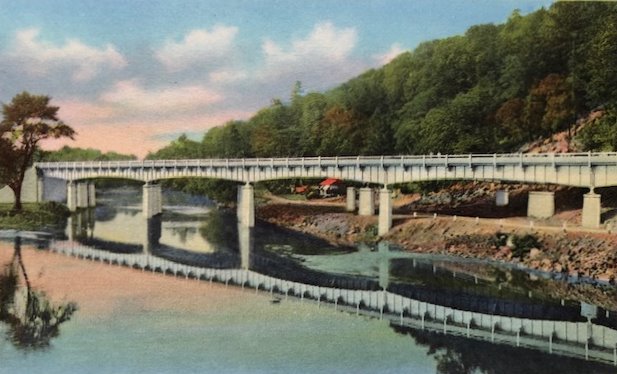
Vintage postcard: Beautiful bridge on Pennsylvania’s Turnpike in the Bedford Narrows.

One of the authors I worked with described his home as “El Rancho Indebto.” That description — from author Daniel Gray’s books, such as Adobe ImageStyler In Depth — has stuck with me even though it has been years since I’ve worked in educational publishing.

Dan had a way of twisting words to make them more interesting amid chapters on how to apply the techniques of web design and develop software expertise. I have to apologize in arrears for probably thwarting some of his descriptions. For example, I remember him writing the lesser-known “stop on a nickel,” and I might have changed it to the tired, old “stopped on a dime.”

In any case, finding the right words, the less tired words, the memorable words, can bring your writing to life. It’s a constant battle I’ve fought by seeking the telling details that deepen scenes.

In my search for the right words, I’ve accumulated a few trusted books that go beyond the thesaurus and Google searches. Books I continue to turn to include:

Random House Word Menu by Stephen Glazier – Struggling to describe the lights and mirrors in a setting? This reference gives you a list, along with short definitions, to help you decide if your setting has a gaslight or a torchiere. A pier glass or a looking glass. See the “Lamps and Mirrors” section.

The Describer’s Dictionary by David Grambs – The subtitle is “A Treasury of Terms & Literary Quotations for Readers and Writers.” Want to give a character a trademark ring or pendant? Scan the “Common Emblems and Symbols” chapter. Consider the implications of whether your character would wear a peaceful ankh (a “loop-topped cross”) or a human skull, “as a symbol of mortality, death’s head, memento mori.” This book is half word lists and half literary excerpts so you can see how authors have employed these details.

DK Ultimate Visual Dictionary – This book is all about images and labels. Want to know the name for that little chute between your character’s nose and lips? A philtrum. (As an aside, some believe the width of this chute is an indicator of a person’s fertility.) Need your character to encounter a horse and touch its leg or head? You might want to know the difference between a fetlock and a forelock. A fetlock is a joint somewhat similar to a human’s ankle, and a forelock is the hair between a horse’s ears that often falls forward like bangs.

The Emotion Thesaurus: A Writer’s Guide to Character Expression by Angela Ackerman & Becca Puglisi – This book is part of a series of emotion and setting thesauruses. Want to go beyond saying your character is upset? Look at the “Agitation” chapter and browse through the physical signs, internal sensations, mental responses, and other cues to deepen your character’s responses and lead to telling details. If your character was abandoned or neglected as a child, check another book in the series, The Emotional Wound Thesaurus: A Writer’s Guide to Psychological Trauma for examples, false beliefs, fears, potential personality traits, triggers, and more.

Why turn to books when there’s Wikipedia, Google, and other online resources? The more curated content found within these reference books (whether paper or ebook) can save you from falling into a rabbit hole (or as Dan Gray might say, a woodchuck hole) of clicks.

And speaking of clicks and tired descriptors, check your writing against the visual essay “The Physical Traits that Define Men & Women in Literature” written by Erin Davis and illustrated by Liana Sposto at The Pudding.

Davis scanned 2,000 books, including bestsellers, prize winners, and books commonly assigned in U.S. high schools and colleges. She used a language processor to see what body parts and adjectives were most commonly used to describe male and female characters. The interactive visual aspects of the Pudding essay allow you to test some of your assumptions about gender and descriptors. (Thank you to Jane Friedman’s “Electric Speed” newsletter for recommending this article.)