Perseverance: Writing, revising over 30 years leads to published essay

Vintage postcard: The beach at Oceanside, Calif., from “Views Along the Coast Route between Los Angeles and San Diego.”

Good News: The Spectacle publishes “Scorpion Diary”

My personal essay “Scorpion Diary” has been published by The Spectacle, a literary magazine based at Washington University in St. Louis.

“Scorpion Diary” started as an outline of a boxing-type battle scribbled on napkins at a pizza-by-the-slice shop in 1992. The first drafts focused on the woman versus nature conflict, along the lines of, “Whoa, I lived with scorpions.”

Based on paid feedback from a Tahoma Review editor, revisions incorporated more “woman versus nurture” elements, namely the lasting effects of my mother’s alcoholism. Although I had been researching and drafting pieces about women alcoholics for years, Mom had a rock-wall silent treatment. I knew she wouldn’t understand my need to examine our lives in writing, let alone publish what I’d written. After she died, I restarted my work on this and several related projects.

NOTE: Tahoma Review, Craft, and other literary magazines offer paid feedback and critique options. Prices start at a few extra dollars for the “feedback option” on your submission, which yields a paragraph from a magazine editor. Projects that could benefit from in-depth critiques may cost $50 or more (much, much more). As always, select reputable organizations and editors who work with your type of writing. Beware of editors offering promises of greatness if only you’d send them more money.

Given the years I spent in stealth research mode, especially regarding women alcoholics, my source list for “Scorpion Diary” was long. Present-day websites, such as the “Alcohol Self-Assessment Test” from the National Council on Alcoholism and Drug Dependence, continue to prove helpful given the effects of substance abuse on families and children. My oldest source was a doctoral dissertation on Arizona scorpions from 1939.  

The college-instructor frame for “Scorpion Diary” came from chats with two students during a memorable pre-pandemic semester. One student felt she had to choose between supporting her alcoholic mother or pursuing her own goals to get an education and career. Another student was in crisis about how to get through the semester while keeping his family housed. I recognized the parental roles both students took on, complete with the burdens of guilt and Sisyphean responsibilities.

A major revision took “Scorpion Diary” (as well as “Handwashing Dishes,” which was published by Southeast Review) into second-person (you) point of view. Second-person POV helped me navigate glitchy passages that wanted to shift between first-person insights and third-person reportage. Second person offered a balance between emotional distance and experiential immediacy that conveyed more than I ever thought I could back when I was writing on those pizza-place napkins.

Readings that inspired my work in second person continue to include, Cherry, a memoir by Mary Karr, as well as chapters from The Rose Metal Press Field Guide to Writing Flash Nonfiction that focus on writing in second-person.

Bookshelf: Elizabeth Berg’s Escaping into the Open offers a plethora of writing prompts

Vintage postcard: Eagle River and Dam, Copper Country, Michigan.

Writing Prompts. Love them? Hate them?

Most writers can point to a project that started or developed with a prompt.

Prompts prove useful when casting about for fresh writing projects. After all that prompt-based writing, however, steel yourself for slogging through the rubble to find gems.  

Revision work may be where prompt-based writing shines. Approach prompts with an ongoing project in mind. Seek material that deepens your text without sending the project on tangents. The results can be satisfying.

Escaping into the Open

Among the prompts worth visiting (or revisiting) are those in novelist Elizabeth Berg’s Escaping into the Open: The Art of True Writing. The book, which is nearing its 25th anniversary, includes a full chapter of prompts that shows “thinking less and writing more can become a very good habit.” While the book’s publishing industry advice is a bit dated, Berg’s encouragement and guidance on using details to bring writing alive continues to be timeless.    

Field trips

Berg recommends field trips or rather “plunking yourself down in a different environment” and writing about “everything you see and hear and feel, if only to make a list of sensations.”

Documenting the people, as well as your senses, can yield characterizations, such as “nose-ringed teenagers” and “pastel-cardiganed grandmothers,” to replace stickier, clunkier lines.

In terms of setting, Berg recommends focusing on ambient sounds that “can help your readers visualize a place.” For example, tune into the sounds after a church’s prayer vigil or lunchtime at a local diner.

On field trips, seek the details, updated metaphors, and memories (yours or your characters) that give weight to your words. In doing so, run through your senses of sight, sound, smell, touch, and taste.

Speaking of taste and that field trip to a local diner, what would your character crave or try under duress? There’s a special place for food in both fiction and nonfiction writing, especially cuisine linked to a particular setting.

Red Flannel Hash

The opening paragraph of Pam Houston’s short story “The Best Girlfriend You Never Had,” from The Best American Short Stories 1999, does a lot of work and refers to a specific food:  

“A perfect day in the city always starts like this: my fiend Leo picks me up and we go to a breakfast place called Rick and Ann’s where they make red flannel hash out of beets and bacon, and then we cross the Bay Bridge to the gardens of the Palace of Fine Arts to sit in the wet grass and read poems out loud and talk about love.”

Red Flannel Hash? Beets?
Beyond Pam Houston’s story, I explored this new-to-me way to eat beets, one of nature’s so-called superfoods. I recommend this recipe from Taste of Home: https://www.tasteofhome.com/recipes/red-flannel-hash/ The Red Flannel Hash recipe, which includes vegetarian options, calls for corned beef, but I used four slices of bacon to match the description in Houston’s story.

To “prime the subconscious pump,” try some prompt-based drafting and take writing-focused field trips. Consider the following prompt from Berg’s book to get you started:

“Describe five completely different types of people placing their order for coffee with the same waitress. Describe these people in appearance, movement, and speech. If you like, also describe the waitress’s reaction to them.”

Manuscript drafts benefit from a rest

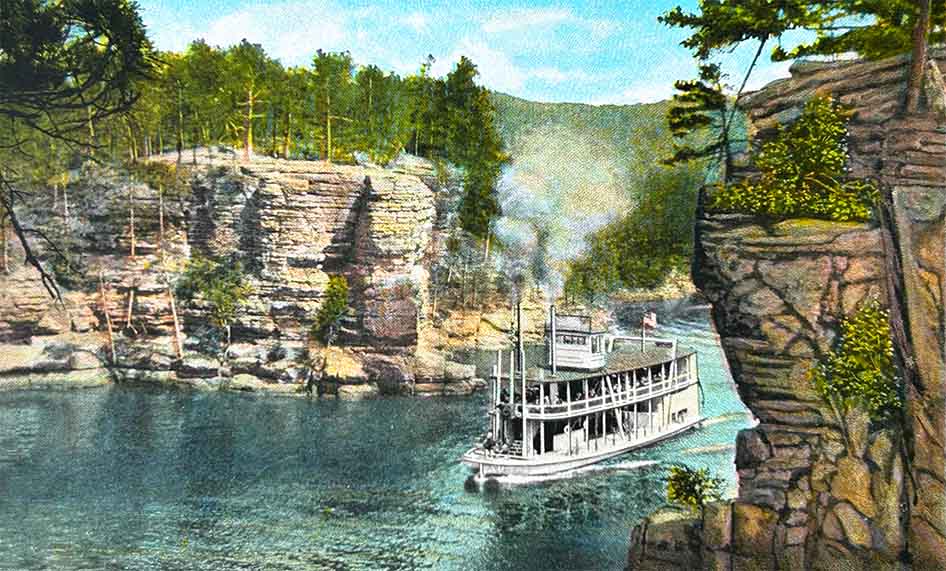
Vintage postcard: High Rock from Romance Cliff, Dells of the Wisconsin River.

Even fresh from summer vacation, taking a break from writing may be just what you need

Sometimes the best thing for your writing is taking a break from your writing. As such, I’ve built in a “rest” period for all non-deadline projects.

For example, after saving a revision, a project might seem good (or even great). Finished.

Resist the temptation to market the manuscript right away, because… When you read that same file a week or more later, any glitches, typos, or flat-out errors will pop.

Save yourself from the cringy rereading of a rejected manuscript and realizing exactly why it was rejected. You probably sent it out months ago, and now, given some time and distance, you can see the problem(s) the editors saw. To make matters worse, most markets won’t accept resubmissions of rejected work, so you’ve burned a market for that project.

A week to the wise

Even when a manuscript feels done, note in your calendar to check it a week from now. If you don’t need to revise when you reread the text next week, the project is probably ready to market. If you revise again, schedule a check another week out.

After a rest period, you’re more likely to approach your manuscript fresh. You see what a reader sees, not what you think you wrote. You’re more likely to hear the glitches or repetitions. You’ll see where content is missing or extraneous—things you thought you covered or cut. Similarly, you are likely to see where the text works well, repeats, or slows to a slog.

A month?

For larger projects or more significant revisions, a month’s rest may be useful. Take a month away to clear your mind of all assumptions. In the meantime, work on other projects, prep work, marketing plans, reading, and so on. You may stumble upon solutions to issues in your work-in-progress that require further revising, restructuring, expanding, or contracting.    

The trick with rest periods is not letting a break turn into abandonment, defeat, or worse. Keep going back, even to those projects that fight you.

Blog roll

See the following blogs/sites for other perspectives on writing breaks:

Recommended reading on the craft of fiction writing: ‘From Where You Dream’ by Robert Olen Butler

From Where You Dream: The Process of Writing Fiction by Robert Olen Butler is a book worth another look

‘Please get out of the habit of saying that you’ve got an idea for a short story. Art does not come from ideas. Art does not come from the mind. Art comes from the place where you dream. Art comes from your unconscious; it comes from the white-hot center of you.” —Robert Olen Butler, From Where You Dream

The best writing craft books transport you. You imagine you’re in a college seminar with an expert creative writing teacher. Unlike typical classrooms, however, these books allow you to work at your own pace.

Such expert teaching by Pulitzer Prize-winner Robert Olen Butler is captured in From Where You Dream: The Process of Writing Fiction, published by Grove Press in 2005.

Tapping into the unconscious, hence the word dream in the book’s title, is one of Butler’s main points. He offers insights into how and when to access your unconscious in the pursuit of art. Butler uses examples from his own, often messy, writing process to illustrate the yeoman work and perseverance required.

“You must … desire to create works of fiction that will endure, that reflect and articulate the deepest truth about the human condition,” Butler says in greeting his students. “I will take your aspirations seriously, and I will demand that you take them seriously.”

If your fiction is good, but not quite resonant or true, Butler’s insights and process tweaks may help you level up. The process won’t be simple or easy. However, the difference might be between creating fiction where you can pick almost any line and find something sensual, telling, and fresh (hint: Gabriel Garcia Marquez) versus writing that just gets the job done.  

For instance, to access the unconscious, Butler recommends journaling for 45 minutes to an hour, especially in the morning, as close to emerging from your dreams as possible. Similarly, journaling before sleep may also prime unconscious consideration.

“But here’s a certain kind of journal that might be useful to you: at the end of the day or beginning of the next day, return to some event of the day that evoked an emotion in you,” Butler says. “Record that event in the journal. But do this only—only—moment to moment through the senses. Absolutely never name an emotion; never start explaining or analyzing or interpreting an emotion…. Such a journal entry will read like a passage in a novel, like the most intense moment-to-moment scene in a novel.”

In discussing story drafts, both his own and those of students, Butler often focuses on the work of evoking emotion in fiction. You’ll better appreciate Butler’s feedback on resisting the urge to include labels or analysis within the writing after reading the drafts yourself. You’ll see what he identifies as working or not, as well as how his feedback may or may not align with yours.

For many, reading others’ rough drafts isn’t a favorite part of writer’s workshops (the type of class the book documents with help from co-author and teacher Janet Burroway). By examining student work, however, Butler’s book “shows” his teaching, instead of just telling. Learning by example often has more staying power than any lecture could.

Robert Olen Butler received the Pulitzer Prize for fiction in 1993 for his short story collection, A Good Scent from a Strange Mountain, and he continues to write literary novels, short stories, nonfiction, and more. He has decades of experience teaching creative writing, most recently at Florida State University. Butler’s innovations in writing and teaching have included his “Inside Creative Writing” series on YouTube, which invites viewers to look over his shoulder as he writes a new short story.


Worth another look…