Perseverance: Writing, revising over 30 years leads to published essay

Vintage postcard: The beach at Oceanside, Calif., from “Views Along the Coast Route between Los Angeles and San Diego.”

Good News: The Spectacle publishes “Scorpion Diary”

My personal essay “Scorpion Diary” has been published by The Spectacle, a literary magazine based at Washington University in St. Louis.

“Scorpion Diary” started as an outline of a boxing-type battle scribbled on napkins at a pizza-by-the-slice shop in 1992. The first drafts focused on the woman versus nature conflict, along the lines of, “Whoa, I lived with scorpions.”

Based on paid feedback from a Tahoma Review editor, revisions incorporated more “woman versus nurture” elements, namely the lasting effects of my mother’s alcoholism. Although I had been researching and drafting pieces about women alcoholics for years, Mom had a rock-wall silent treatment. I knew she wouldn’t understand my need to examine our lives in writing, let alone publish what I’d written. After she died, I restarted my work on this and several related projects.

NOTE: Tahoma Review, Craft, and other literary magazines offer paid feedback and critique options. Prices start at a few extra dollars for the “feedback option” on your submission, which yields a paragraph from a magazine editor. Projects that could benefit from in-depth critiques may cost $50 or more (much, much more). As always, select reputable organizations and editors who work with your type of writing. Beware of editors offering promises of greatness if only you’d send them more money.

Given the years I spent in stealth research mode, especially regarding women alcoholics, my source list for “Scorpion Diary” was long. Present-day websites, such as the “Alcohol Self-Assessment Test” from the National Council on Alcoholism and Drug Dependence, continue to prove helpful given the effects of substance abuse on families and children. My oldest source was a doctoral dissertation on Arizona scorpions from 1939.  

The college-instructor frame for “Scorpion Diary” came from chats with two students during a memorable pre-pandemic semester. One student felt she had to choose between supporting her alcoholic mother or pursuing her own goals to get an education and career. Another student was in crisis about how to get through the semester while keeping his family housed. I recognized the parental roles both students took on, complete with the burdens of guilt and Sisyphean responsibilities.

A major revision took “Scorpion Diary” (as well as “Handwashing Dishes,” which was published by Southeast Review) into second-person (you) point of view. Second-person POV helped me navigate glitchy passages that wanted to shift between first-person insights and third-person reportage. Second person offered a balance between emotional distance and experiential immediacy that conveyed more than I ever thought I could back when I was writing on those pizza-place napkins.

Readings that inspired my work in second person continue to include, Cherry, a memoir by Mary Karr, as well as chapters from The Rose Metal Press Field Guide to Writing Flash Nonfiction that focus on writing in second-person.

On Becoming an Adjunct Instructor: 3 sources for further reading

Vintage postcard: Driveway in Busch’s Sunken Gardens, Pasadena, Calif.

Good News: Inside Higher Ed publishes career advice for adjunct faculty

My cautionary essay, “Advice to a Friend on Becoming an Adjunct,” has been published by Inside Higher Education.

The idea and structure for the essay came from reading Benjamin Franklin’s “Advice to a Friend on Choosing a Mistress,” which dates back to 1745. I saw similarities between Franklin’s words and present-day discussions of adjunct faculty. You may remember one of the Franklin’s oft-quoted lines, “And as in the dark all cats are grey…”

DEFINITION: Adjunct faculty may be called lecturers, faculty associates, or similar titles. Adjunct or contingent faculty are contracted to teach one or more university courses each semester. While they are not on the tenure track, adjunct faculty hold advanced degrees in their subject areas, and teaching may be their full-time job. 

I began drafting this essay after receiving an adjunct teaching contract with a per-course pay rate so low that it was similar to my first teaching contract in 2000.

Regrets surged at having stayed with adjunct teaching and its attendant fears of losing full-time work (and health insurance) every fall and spring. Looking back, I would have advised myself to exit the academic treadmill of year to year or semester to semester contracts and re-enter the ranks of higher ed. classified or professional staff—jobs that offer more stable schedules, competitive incomes, and maybe even raises.

In any case, the Inside Higher Ed essay offers advice I wish someone had told me (or that I had listened to). If you’re interested in some of my sources, I’d like to share the following:

Sources (partial list)

The Adjunct Underclass: How America’s Colleges Betrayed Their Faculty, Their Students, and Their Mission, University of Chicago Press book

The Adjunct Underclass: How America’s Colleges Betrayed Their Faculty, Their Students, and Their Mission by Herb Childress, a former dean at the Boston Architectural College, was published by the Chicago University Press in 2019. The book offers “Recommendations for Survival in the Current Climate,” including that grad students should consult the National Research Council’s assessment of doctoral programs. “Be cautious about applying to any school not in the top 10 percent of its discipline,” writes Childress. “Lots of doctoral programs can give you a wonderful intellectual experience; only a few of the are likely to give you a chance in the [higher ed.] labor market.” To further gauge one’s prospects for a career in academia, Childress’s self-test, “The Academic Career Calibration Protocol,” may feel like an ice-water dunk.

Who Are the Part-Time Faculty: There’s No Such Thing as a Typical Part-timer,” American Association of University Professors article

Who Are the Part-Time Faculty: There’s No Such Thing as a Typical Part-timer” by James Monks, an economics professor at the University of Richmond, Va., was published in AAUP’s Academe in July-August 2009. The article includes a plethora of economic, demographic, and related data about contingent faculty. “[P]art-time non-tenure track faculty earn between 22 and 40 percent less than tenure track assistant professors on an hourly basis,” writes Monk in citing his earlier article, “The Relative Earnings of Contingent Faculty in Higher Education,” which was published by the Journal of Labor Research in 2007. Monks’s earning percentages seem high, based on my years in the adjunct world at Wisconsin and Arizona universities.  

Professional Identity in a Contingent-Labor Profession: Expertise, Autonomy, Community in Composition TeachingWriting Program Administration article

Professional Identity in a Contingent-Labor Profession: Expertise, Autonomy, Community in Composition Teaching” by Ann M. Penrose, an English professor at North Carolina State University, Raleigh, was published in Writing Program Administration in 2012. Among Penrose’s points is a discussion of how a profession is defined to include growth and development. She asks whether contingent instructors are members of a profession/discipline given their often-narrow opportunities for growth. “But under the conditions of contingent employment, ‘professional development’ can easily be interpreted as a euphemism for brainwashing or remediation….,” writes Penrose. Brainwashing is a strong word, but my professional development opportunities related almost solely to practical concerns, such as university technology adaptations, curriculum changes, or course development. “Under this interpretation,” Penrose writes, “professional development activities are intended to regulate and regularize and thus present a clear challenge to an experienced faculty member’s autonomy and professional identity.”

Other Sources

Publications regularly covering issues concerning adjunct university instructors, such as unionization efforts, include:

Related post

Thinking about a college teaching gig?

Flash nonfiction: Good news and a field guide recommendation

Vintage postcard: Bungalow scene in Santa Ana, Calif.

Good news

I’m happy to share that my flash nonfiction piece “Handwashing Dishes” has been published online by The Southeast Review.

The Southeast Review, established in 1979 as Sundog, is a national literary magazine housed in the English Department at Florida State University, Tallahassee, and is edited and managed by its graduate students and a faculty consulting editor.

I especially appreciated working with Nonfiction Editor Liesel Hamilton, a Ph.D. candidate in nonfiction writing. She asked smart questions during the editing process, and her attentions truly made the piece better.

What is flash nonfiction?
“I am including creative nonfiction work up to 2,000 words, though the great majority of what is discussed is briefer: 500 to 1,000 words, and sometimes even fewer…. [L]ike literary fiction and poetry, the nonfiction we discuss is marked by the distinct, often peculiar, voice and sensibilities of the author and these works examine the deeply human—and often unanswerable—questions that concern all serious art…. [T]he work itself is individual, intimate, exploratory, and carefully crafted using metaphor, sensory language, and precise detail.” (xiv)
—Dinty W. Moore, The Rose Metal Press Field Guide to Writing Flash Nonfiction  

Flash nonfiction field guide

If you’re interested in writing flash nonfiction, I recommend The Rose Metal Press Field Guide to Writing Flash Nonfiction edited by Dinty W. Moore. As the subtitle says, the book offers “advice and essential exercises from respected writers, editors, and teachers.”

The chapter “Memory Triggers and Tropes” by Rigoberto Gonzalez of Rutgers University was especially helpful in drafting “Handwashing Dishes.” The prompt Gonzalez wrote starts with a useful distinction:

“Recall a memory that has emotional (not sentimental) value for you. To differentiate, an emotional response is attached to reason or thought and makes you ask (and want to answer) who, what, where, why, and how; a sentimental response is attached to feeling and simply asks those same questions without seeking to assess or investigate them.” (35)

Emotional vs. sentimental

The idea of a memory with emotional value immediately made me think about the dishes. They helped me unlock the memory of flying across the country to check on my mother’s welfare after being called by the Phoenix police. I needed to write about the state of my mother’s kitchen and family memories I’d been trying to make sense of for years.    

As I drafted and re-drafted the story, finding the right point of view held me back. A straight reportage third-person version (she/they) seemed too detached and clinical. Meanwhile, a first-person version (I) was too much about me. The second-person point of view (you) offered a balance between emotional distance and experiential immediacy that fit.

Two chapters from The Rose Metal Press Field Guide to Writing Flash Nonfiction focused on writing in second-person. When I read Dinah Lenney’s chapter, “All About You,” I saw similarities in our approaches to second-person narration.

Hey, you! (second-person narration)

We both started with research. I remembered the second-person point of view in Jay McInerney’s novel Bright Lights, Big City from grad school. Lenney of the University of Southern California offered a longer list. She included “Carlos Fuentes, Marguerite Duras, Nathaniel Hawthorne, Samuel Beckett, Jhumpa Lahiri, Rumer Godden, Edwidge Danticat, Junot Diaz, Italo Calvino, William Faulkner, etc.” (100).

But what about specifically nonfiction examples? These were more elusive. I added Mary Karr’s Cherry: A Memoir to the list because the book starts with a second-person prologue.

In Lenney’s chapter, she used her flash nonfiction “Little Black Dress” as an example while pointing out what using second-person narration allows a writer to do. She writes, “it slows down the pace of things so that the story happens to you and your reader at about the same time—both of you there, in the middle of whatever it is, however delightful or excruciating” (102).

This slowing down that Lenney refers to helped me see the bigger picture connected to a scene worthy of a squalor documentary. It wasn’t just a weekend of trying to set things to right, there were things that couldn’t be fixed simply with a clean kitchen.

Research (library databases)

The key was further research. I read about the work-related trauma that can impact medical professionals. Mom used to tell me operating room stories—mangled motorcycle riders, disfiguring cancer surgeries, and aneurysms where blood pooled on the floor. She and many career nurses work through physical hazards, such as back injuries from lifting heavy patients, as well as mental trauma. Research into the toll of the health care professions acknowledges the effects of these traumas and helped me see the connection to my mother.  

The combination of research into Mom’s work as a nurse—as well as into the craft of flash nonfiction and second-person narration—helped me make sense of lingering images from her house. To borrow language from Rigoberto Gonzalez, the flash nonfiction form allowed me to highlight a “moment of awareness or awakening that will resonate for a lifetime” (34). The writing helped me get closer to answers that had eluded me.

Good news and a poetry writing prompt: Pantoum

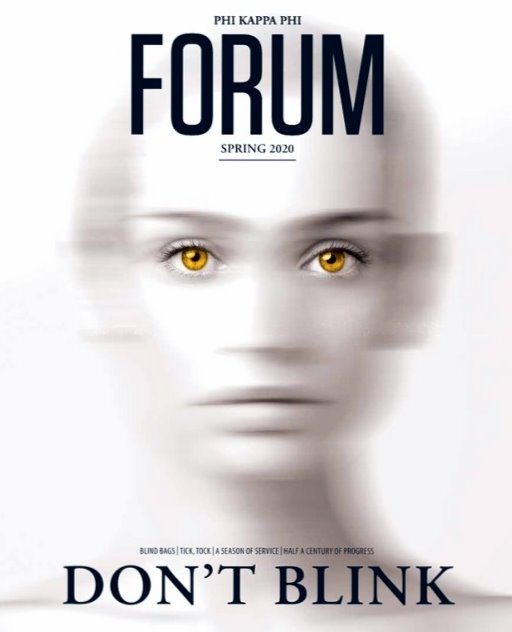
My poem “The Choice” has been published in the spring 2020 issue of Phi Kappa Phi Forum, an honor society magazine. Here are the poem’s first two stanzas:

                 “The Choice”
I would not wish you to pass.
I would press my hand into your palm
and hope my distress stirs you to choose.
Override the machines. Grab on or let go.


I would press my hand into your palm
and pray for a reflex, anything.
Override the ventilator. Grab on or let go.
Breathe or stop on your own.


The year after my father collapsed with respiratory failure I spent a lot of time, usually alone, in waiting rooms—surgery, ICU, radiology, and more. So many waiting rooms in three hospitals and five care facilities in two states.

PKP Forum 2020 springb

The high stakes, the uncertainties, the complications made fiction reading (my usual pastime) difficult. I turned to reading and writing poetry. One of the books I read was Edward Hirsch’s Poet’s Choice, which introduced me to Indian poet Reetika Vazirani and her work.

Vazirani’s three-line poem “Lullaby” stuck with me. And I found myself using Vazirani’s poem as a model. I wrote of my father’s situation over and over, never finding the right words until I learned a poetry form called the pantoum.

The repetition and circling back of the pantoum’s form helped me synthesize the prayer poems I had drafted during my father’s eleven ventilator-dependent months. These months included three times when doctors recommended extubation—twice while my father was unconscious and once while he was awake and clearly not ready to die.

“The Choice,” in the form of a pantoum, helped me to work through this ultimate decision.

Writing exercise

I’ve been curious as to whether the writing process I used might work again with different subject matter (for example, the social isolation of sheltering in place).

  1. Write about your own subject/topic using Reetika Vazirani’s poem as a model for phrasing, line breaks, and so on. Keep writing and writing until you have multiple versions and approaches and angles and voices. Here’s Vazirani’s poem:
                      “Lullaby”
     I would not sing you to sleep.
     I would press my lips to your ear
     and hope the terror in my heart stirs you. 
                     —by Reetika Vazirani (1962–2003)
  1. From among your drafts, highlight the line or lines that “say it best.” Consider which one might work as the first line of your pantoum. Note: This will also become the last line of your pantoum.
  1. Continue working with material from your drafts within the pantoum structure. One interesting aspect of using this structure is that as you write a stanza, you are also writing two of the lines for your next stanza.
        Here’s the pantoum structure of four-line stanzas, notice the repeats:
A
B
C
D
B (a repeat)
E
D (a repeat)
F
E (a repeat)
G
F (a repeat)
H
G (a repeat)
I
H (a repeat)
A (line 1 repeats)

Pantoums aren’t limited to four stanzas, as my outline shows. They can be any length.

Note: When I worked through this process, I titled my “Lullaby”-based drafts. Some of the drafts were “Prayer,” “Meditation,” “Hope,” “Will,” and “No Words.” Ultimately, these titles helped me organize the different approaches and points of view. I encourage you to title your “Lullaby”-based drafts.

  1. Then, edit, review/peer review, revise, and repeat.

When you need more information or inspiration, it helps to search for and read pantoums on the Academy of American Poets website poets.org or on the Poetry Foundation website poetryfoundation.org. You’ll notice how some poets make slight adjustments in the repeats, while others are to-the-letter faithful in their repetitions.

If you try this writing exercise, I’d be interested to hear about what does or doesn’t work, including your resulting work. If you feel comfortable, please post a comment.

“To Walk Chalk” in Superstition Review

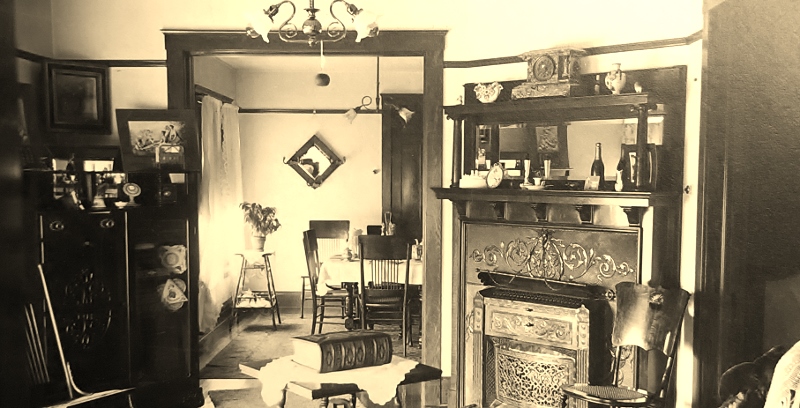
1898 house parlor to dining room (800x408) (2)

My story “To Walk Chalk” has been published in Superstition Review, an online literary magazine at Arizona State University. (The review staff was wonderful to work with, and they run a great website.) Here’s the link to the short story: “To Walk Chalk.”

The setting for this story stuck with me years after seeing a newspaper ad for Sharer’s Funeral Parlor and Mortuary in my grandmother’s scrapbook. The address for the mortuary was the same as the house my great-great-grandfather had built in 1898 in a small Wisconsin town known for tobacco farming. My grandmother had lived in that house for the majority of her eighty-plus years.

Problem: No one in the family had ever been in the mortuary business. No one in the family had the last name Sharer.

Answer: The family home had been rented out during the Great Depression.

Only after learning this did it make sense why my grandfather had once told me, “They embalmed people in the basement.” I must have been twelve when he said this, and it changed my perception of the basement forever.

The house is no longer in the family, but we have pictures such as the parlor scene above. And now some of my memories have been spun into the short story, even if I modified the description of the house’s exterior to include details from at least two other Wisconsin buildings.