Vintage postcard: High Rock from Romance Cliff, Dells of the Wisconsin River.
Even fresh from summer vacation, taking a break from writing may be just what you need
Sometimes the best thing for your writing is taking a break from your writing. As such, I’ve built in a “rest” period for all non-deadline projects.
For example, after saving a revision, a project might seem good (or even great). Finished.
Resist the temptation to market the manuscript right away, because… When you read that same file a week or more later, any glitches, typos, or flat-out errors will pop.
Save yourself from the cringy rereading of a rejected manuscript and realizing exactly why it was rejected. You probably sent it out months ago, and now, given some time and distance, you can see the problem(s) the editors saw. To make matters worse, most markets won’t accept resubmissions of rejected work, so you’ve burned a market for that project.
A week to the wise
Even when a manuscript feels done, note in your calendar to check it a week from now. If you don’t need to revise when you reread the text next week, the project is probably ready to market. If you revise again, schedule a check another week out.
After a rest period, you’re more likely to approach your manuscript fresh. You see what a reader sees, not what you think you wrote. You’re more likely to hear the glitches or repetitions. You’ll see where content is missing or extraneous—things you thought you covered or cut. Similarly, you are likely to see where the text works well, repeats, or slows to a slog.
A month?
For larger projects or more significant revisions, a month’s rest may be useful. Take a month away to clear your mind of all assumptions. In the meantime, work on other projects, prep work, marketing plans, reading, and so on. You may stumble upon solutions to issues in your work-in-progress that require further revising, restructuring, expanding, or contracting.
The trick with rest periods is not letting a break turn into abandonment, defeat, or worse. Keep going back, even to those projects that fight you.
Blog roll
See the following blogs/sites for other perspectives on writing breaks:
Gotham Writers instructor Brandi Reissenweber’s starts with, “You might simply need some time away from the story” in response to the question, “After I get done with a first draft of a story, revision feels overwhelming. How can I keep going and not lose my momentum?”
Vintage postcard: Chicago, Minneapolis & St. Paul Railway Depot, Stoughton, Wisconsin.
Lit-mags lose when colleges and universities consolidate, cut back or close
Sometimes campus mergers in higher education can result in orphaned or abandoned literary magazines. More lit-mags may become unresponsive or inactive as colleges and universities continue to consolidate, cut back, or close.
Example: University of Wisconsin System mergers
A decade ago, many of Wisconsin’s 26 state universities and colleges had literary magazines.
Wisconsin had 13 four-year state universities and 13 state-run two-year colleges (separate from technical and private colleges).
Today, several of those literary magazines (most often from two-year colleges) are no longer publishing after a shuffling and reshuffling of campuses.
Two rounds of mergers brought Wisconsin’s two-year colleges under the umbrellas of nearby four-year state universities. The UW System now describes itself as, “13 universities across 26 campuses…”
Case study #1: Luce
Luce was the literary magazine at the University of Wisconsin-Sheboygan (a two-year college). When the UW System reorganized and then reorganized yet again, UW-Sheboygan became UW-Green Bay’s Sheboygan Campus. In other words, UW-Sheboygan became part of a four-year university. However, UW-Green Bay already had its own literary magazine, SheepsheadReview, and Luce faded away (at least for now).
Elsewhere in the UW System, other college lit-mags may not have survived campus mergers or related changes, including:
The Windy Hill Review at UW-Waukesha (now UW-Milwaukee at Waukesha County)
Fox Cry Review at UW-Fox Valley (now UW-Oshkosh, Fox Cities Campus)
Mush Literary Magazine at UW-Marathon County (now UW-Stevens Point at Wausau)
Rock River Review, at UW-Rock County (now UW-Whitewater at Rock County)
Others?
No longer anyone’s job
Mergers are often made in the name of cost-cutting. In higher-ed mergers, almost all university employees see their jobs change. The faculty members or university staff who advised or managed literary magazines usually see new (or modified) work assignments, as well as increased workloads. These job changes may not include their previous lit-mag work.
Supposed redundancies
Administrators hunt down opportunities for cost savings in any campus merger. It’s not hard to guess their reactions upon realizing that after a merger they have not only one lit-mag to support, but maybe two or three more as well. Chop! Mergers and “redundancies” don’t mix.
What’s a writer to do?
On their websites and Submittable listings orphaned or abandoned university lit-mags may appear to be operating with business as usual. Information about behind-the-scenes staffing and funding changes may not be announced.
As always, writers should look for proof of life, so to speak, such as updated website content and recent publications. Also, check out Duotrope and other sources of literary marketplace information.
Even after doing their research, writers may discover that they’ve submitted work to a university lit-mag that has gone silent. No responses. No publications. Nothing.
What about submissions and fees?
Note that some orphaned lit-mags may continue accepting submissions and submission fees. My sense is that this is an oversight (not intentional), at least for university publications. And I hope refunds would be arranged.
For what it’s worth, major scheduling and staffing changes in higher ed often occur during the lull between academic years, namely in the summer. A magazine’s faculty adviser or manager may end an academic year with the publication of a magazine they hope won’t be their last. By the time fall rolls around, the class or the program or the paid jobs that supported that literary magazine may be gone. Who’s left to mind the lit-mag when the paid staff’s gone and the student workers have likely graduated or moved on with their degree programs?
Case study #2: Green Mountains Review
The home campus of Green Mountains Review used to be Northern Vermont University. Currently, the NVU website leads with, “We’re Now Vermont State University!” This points to yet another campus merger.
As a writer, I’ve had a manuscript “in progress” at Green Mountains Review since February 2022. I discovered the university’s name change/merger info when checking to see what was going on at the lit-mag. In other words, I was wondering about the lag, especially upon seeing their website’s last news item was from November 2022.
I’m not alone in wondering about Green Mountains Review, according to a recent Lit Mag News article “Who holds lit mags accountable?” by Becky Tuch. She asks useful questions about who is accountable for unresponsive or inactive lit-mags, especially when submission fees are involved, such as the $3 that Green Mountains Review had collected for each submission until recently.
In today’s environment of increased university cuts, the tally of orphaned or abandoned lit-mags may continue to grow, reducing opportunities for writers, editors, designers, readers, and more.
Vintage: Mystic Tray from Haskelite Manufacturing of Chicago.
5 podcasts & online readings for going scarily into the night
It all started with “Goblin Market” by Christina Rossetti, or rather podcaster Jacke Wilson’s reading and discussion of “Goblin Market” on his History of Literature Podcast. Although the episode was available months earlier, I didn’t get to it until last October, and it was perfect for Halloween.
As the autumn holidays approach, I’m looking for more Halloween podcast goodness — a healthier pastime than, say, a trip to the candy stash that’s supposed to be for the trick-or-treaters.
Here’s some of what I found (or returned to):
1. “Goblin Market”
Already mentioned… Episode 415 “Goblin Market” by Christina Rossetti on the History of Literature podcast. Rossetti’s extended narrative poem follows “two sisters seduced by the fruits being sold by a pack of river goblins,” writes Wilson.
See the Poetry Foundation’s website for the full text of Rossetti’s “Goblin Market” from Goblin Market and other Poems, originally published in 1862.
2. “The Tell-Tale Heart”
“The Tell-Tale Heart” by Edgar Allan Poe – History of Literature’s episode 450. The classic dark tale benefits from Wilson’s discussion of Poe’s life and the story’s oh-so-telling details.
See the Poe Museum’s (Richmond, VA) website for full text of “The Tell-Tale Heart,” which was first published in 1843.
3. “Spooky Stuff! Halloween Romance”
“Spooky Stuff! Halloween Romance Interstitial” – For romance novel fans, this episode from the fifth season of the Fated Mates Podcast recommends “some of our favorite recent witches and demons and incubii and ghosts and vampires and others,” write hosts Sarah MacLean and Jen Prokop. The hosts also “try to get to the bottom of why paranormal romance and monster romance [don’t] feel like Halloween romance.” NOTE: Adult themes, NSFW, headphones recommended, etc.
4. Apex Magazine
Apex Magazine’s Episode 99 featuring “Over Moonlit Clouds” – For dark speculative fiction, including this lycanthropic/aviation/societal dilemma by Coda Audeguy-Pegon, check out Apex Magazine, which posts narrated versions of its stories regularly.
Return to these podcasts and publications for recent offerings about, say, “The Legend of Sleepy Hollow,” “devils” in the romance genre, or just more of the “Strange. Surreal. Shocking. Beautiful.”
Vintage postcard: Forest Drive, Near Observatory Tower, Peninsula State Park, Door County, Wisconsin.
For some reason, meeting writing goals and finishing projects seem more difficult these days.
What’s getting in the way of your writing?
Is it the specter of AI replacing you as a writer? Or fears that AI could copy, replicate, and surpass your writing, as has happened to some visual artists?
How about the publications (markets) you’ve been watching that closed to submissions while they figure out how to handle all the AI-generated stuff?
Is it the revelations about contests/lit mags/publishers that continue to accept submissions (and fees) but never publish anything or much of anything?
Have you received just one rejection too many?
Is it that life is getting back to normal, and suddenly there’s so much to do (besides writing) now that lockdowns are in the rearview?
Is it just summer?
Is it just me?
Setting writing goals, seeking inspiration, and addressing common frustrations seem to help. Or at least they sound good. Here are a few resources for writers:
1. 1000 Words of Summer
In her Poets & Writers Magazine article, “1000 Words of Summer: How an Accountability Project Opened Up My Writing Life,” Jami Attenberg discusses how a now-worldwide project started, “In 2018 my friend Anne Gisleson and I decided to write a thousand words a day, every day, for two weeks straight.” The #1000wordsofsummer project’s sixth year started on June 17, 2023, and Attenberg has been posting daily on her Craft Talknewsletter, as well as on Instagram and Twitter. Even if you’re starting this project late, there’s still time to read the newsletters and get a writerly boost.
2. Field Trips for Serendipity & Inspiration
Maybe you feel like you don’t have time to peruse a book or take a field trip, but maybe you’ll find information you need (a key, an inspiration) from an unexpected source. What book or artwork or object practically jumps out at you? Here are a few places that might coax creativity your way:
The recent releases shelf at your local library. What catches your eye? How might a source connect to your works in progress?
Museums, galleries, resale shops, flea markets, and more. Again, what are you drawn to? Ask yourself what the visuals, objects, and their histories could contribute to your writing. Maybe do some people watching too. For instance, I once saw a goateed woman haggling with a burly vendor over sewing notions at a swap meet.
Immersion in tastes, smells, and sounds. Indulge your senses at spice shops, confectionaries, farmer’s markets, ethnic restaurants, neighborhood sporting events, music recitals, and more. Sometimes just listening to buildings—the different sounds inside a high-rise and a hospital—can alert you to telling details for your writing.
3. Websites for Writers
Moderation (avoiding rabbit holes) is important, especially with websites, but sometimes hearing what other writers are saying is reassuring:
Writer Unboxed: This website “is dedicated to publishing empowering, positive, and provocative ideas about the craft and business of fiction… [T]he site now hosts more than 50 contributors, including bestselling and rising authors and industry professionals.”
Writer’s Digest’s 101 Best Websites for Writers: Past categories have included: Best Live Streams, Podcasts, and YouTube Channels for writers; Best Writing Advice Websites (including Writer Unboxed); and Best Genre/Niche Websites. The 2022 list came out in July, so the 2023 listings should be published soon.
In the end, doing something (anything short of a bonfire) with your writing is more productive than the alternative, right?
Vintage postcard: Aquarium, Belle Isle, Detroit, Michigan.
The literary magazine universe doesn’t need to be this way:
Editors frustrated by an avalanche of manuscripts that are wildly inappropriate for their publication’s audience, mission, or market. Mismatched texts clog their submission portals, consume their time, and leave them so cranky that when they actually find a promising text, they may be too tired or frustrated to acknowledge it.
Writers clueless as to why they’re being rejected again, and again, and again. The whole submission process begins to feel like throwing darts at balloons in some literary carnival game. Merely a word or three of feedback from an exhausted editor feels like a win.
Readers struggling to understand what makes one literary magazine different from another. For example: Which literary magazine is sure to offer eco-fiction and eco-poetry? Which magazine tends to provide eye-opening perspectives from X community?
These types of misalignments aren’t unique to the publishing world. In teaching, an instructor may fail to communicate how course learning outcomes align with class activities. Think back to times when you were unpleasantly surprised about what was on a test. In business, an inept manager may harp on minutia (such as using envelopes that cost 8 cents vs. 9 cents apiece) while rewarding only mission-related work with year-end raises.
Both teachers and managers, should look at themselves first when they don’t receive what they want in terms of performance. The same can be said for lit mags and their editors.
What is a lit mag (short for literary magazine)?
Wikipedia offers the following, “A literary magazine is a periodical devoted to literature in a broad sense. Literary magazines usually publish short stories, poetry, and essays, along with literary criticism, book reviews, biographical profiles of authors, interviews and letters. Literary magazines are often called literary journals, or little magazines, terms intended to contrast them with larger, commercial magazines.”
Wikipedia includes a brief history of literary magazines, as well as a link to a “List of literary magazines.” Also see writer Clifford Garstang’s helpful 2022 Literary Magazine Ranking, a yearly compilation he bases on Pushcart Prize results.
Communication can be the key to reducing the churn in literary magazine submissions. Unfortunately, mission statements and “About Us” webpages are often vague, such as “We want to publish the best fiction, poetry, and creative nonfiction available.” What does “best” mean? Each staff member may approach or define “best” differently.
Subgenre overload
Market listings for literary magazines — whether in Submittable, Duotrope, annual Writer’s Market books, or elsewhere — often push editors to offer more specifics about what they want to publish. This can be useful. However, such listings may also exacerbate miscommunication, especially in regard to subgenres. How much do you know about a lit mag that says it publishes a laundry list of subgenres?
For example, the Poets & Writers literary magazine database lists 38 potential subgenres, and recently a reputable Midwestern literary magazine designated 32 of them and excluded only six:
Autobiography/memoir
BIPOC voices
Commercial fiction
Creative nonfiction
Cross-genre
Erotica
Experimental
Feminist
Fiction
Flash fiction
Formal poetry
Graphic/illustrated
Graphic/health
Historical
Humor
Journalism/investigative reporting
LGBTQ voices
Literary fiction
Love
Lyric essay
Micro-poetry
Narrative nonfiction
Nature/environmental
Nonfiction
Poetry
Political
Pop culture
Prose poetry
Regional
Religious/spiritual
Serialized fiction
Short fiction
Speculative fiction
Speculative poetry
Translation
Visual poetry
War
Young adult
How much does a list of 32 subgenres tell writers, readers, or even staff members about a lit mag? From the editorial side, the rationale may be to keep options (or subgenres) open. But writers have likely responded with a raft of everything-goes submissions.
On the plus side, broad mission statements or subgenre lists offer flexibility for a magazine’s management, especially for college and university publications that change editors yearly. However, the outside view of vague descriptions or jargony missions is that the publication’s editorial targets are constantly shifting.
An unfortunate result is that the common advice to read a magazine to familiarize yourself with what it publishes often doesn’t work with the broad missions and shifting staffs of some publications. For example, one year a lit mag editor may include mermaid and ghost stories, but editors in previous and following years may reject such stories at the first hint of merpeople or specters.
Theme issues
Theme issues or special sections may be useful for editors, writers, and readers facing unclear or outdated mission statements.
Some publications, such as Fairy Tale Review, set a theme for each issue. Other magazines, such as Creative Nonfiction, intersperse theme and “regular” issues. When editors communicate their themes they often offer more information and details that help writers align and target their submissions.
A couple examples of upcoming theme issues (and their deadlines) include:
Creative Nonfiction. Theme: “Caring for the Heart.” Deadline 1/23/2023. “For an upcoming issue, Creative Nonfiction is seeking new narratives about caring for the heart — medically, technologically, or metaphorically. We’re looking for stories from healthcare workers and researchers; counselors and cardiologists and coaches; nurses and nutritionists … or any red-blooded writer with a heart.” See Creative Nonfiction’s website to continue reading the submission call.
Fiction International. Theme: “Refugee.” Deadline: 2/16/2023. “Fiction, non-fiction, and indeterminate prose texts of up to 5,500 words that address the theme of ‘Refugee’ are welcome. We will consider submissions of narrative, anti-narrative and indeterminate texts but only accept submissions reflecting the theme.…” See Fiction International’s Submittable listing for more information, as well as a link to the magazine’s catalog, which might offer insights into “indeterminate texts.”
Vintage postcard: Highway from Torrey Pines, on the Coast Route between Los Angeles and San Diego.
One of the following sentences includes a misused word:
A. “I defiantly think that word should be changed.” B. “I definitely think that word should be changed.”
Although B is preferred here, my students often type “defiantly” when they mean definitely. Neither spellcheck nor the grammar checker flags “defiantly” in this context. Nonetheless, imprecise and awkward word choices can be an issue in college essays, and in business and professional writing the stakes are higher.
Checking dictionary definitions can help pinpoint misused words, but another tactic is hearing your text read aloud.
Microsoft Word has tools for that
The “Read Aloud” tool in Microsoft Word helps you listen to your drafts. Hearing your words can help you identify (and fix) word-choice glitches, subject-verb agreement errors, misspellings, and more. Hearing the word “defiantly” when you meant “definitely” can spotlight a needed revision.
You’ll find “Read Aloud” on the Review screen’s toolbar in Word 2019, Word 2021, and Microsoft 365. You can customize this tool to read faster or slower, pause, skip forward or back a paragraph, and more. For more information, see the Microsoft support page, “Listen to your Word documents.”
If you’re using an older version of Word, you can still get the program to read your text to you. Add the Speak feature to your Word screen by following the five steps detailed by Microsoft at “Use the Speak text-to-speech feature to read text aloud.”
Pro tip: Find a fresh approach
Reading aloud, whether you read to yourself or use tech tools to read to you, is a strategy that professional writers use. I’ve seen reporters in newsrooms whispering their stories to themselves just before deadline. I’ve experienced the deep revision that comes from preparing to record a story for a website.
With text on screens, it can be easy to insert words and adjust sentences as you read. You keep adding the missing words or fixing the awkward sentences in your mind. However, the actual words in your file may say something different. Approaching your text fresh, so that you don’t rely on what should be there versus what is actually there, can help you avoid embarrassing mistakes.
Time can be a great resource for approaching a text fresh. In other words, put away your project for a week or more and then come back to it minus your assumptions. However, time can be a luxury that isn’t available when a due date or deadline is looming.
Whether you’re on deadline or not, hearing your words aloud can give you a fresh perspective that reading on screen over and over can’t.
Multilingual writers
Hearing a text can also be helpful for writers who are working in a second language. In my college writing classes, I’ve had students who are working in English when it’s their second or third language. I can point to a paragraph containing, for example, subject-verb agreement problems. When I ask them to read the paragraph aloud, they often fix the verb tense issues as they speak. They are often surprised when I point out the error in the text—the error they fixed when they read aloud.
For English speakers who are working in other languages, the Read Aloud tool can also be useful. The tool can be set to read in an array of languages.
Vintage postcard: General Motors Building, Chicago World’s Fair, 1933.
Start with the acknowledgment pages
If you read the acknowledgment pages of many novels, nonfiction books, short story collections, and poetry books, you’ll often see where earlier excerpts were published. This can tell you several things, including that the publications listed:
May be something you would like to read
May be markets for your own work
Often, first publications or excerpts appear in literary magazines. If you’re working on your own book or collection, literary magazines may be an important step in your reading, researching, and publishing journey.
For example, in World of Wonders: In Praise of Fireflies, Whale Sharks, and Other Astonishments, Aimee Nezhukumatathil’s 2020 book, the acknowledgments include literary magazines such as Brevity, Diagram, Ecotone, and Georgia Review.
Bully Love, Patricia Colleen Murphy’s 2019 poetry collection, lists acknowledgments for Hawaii Review, Heliotrope, Indiana Review, and many other publications.
Finding literary magazines
Finding information about the literary magazines listed on an acknowledgments page is an online search away. However, reading the stories, poems, and essays they publish can get tricky. The spectrum of literary magazines ranges from fully online to print-only magazines that publish zero content online.
Reading content
Reading online literary magazines can be as easy as signing up on their websites, but reading print-based magazines may involve ordering print or electronic copies of individual issues. Some magazines offer pdf versions of recent back issues that may be available for reduced prices and quick access.
Don’t skimp on reading. An important part of the submission process is familiarizing yourself with individual literary magazines. Research what they’ve published. A friend of mine from grad school didn’t do this, and he ended up with a publication that he finds embarrassing to this day.
Submitting work
Submission windows for literary magazines may vary from one week to year-round. A few don’t accept any unsolicited work. Tactics to find these submission windows and writers’ guidelines start with a magazine’s website. If the magazine offers a newsletter, sign up to receive alerts about content, contests, submissions, blog posts, and (yes) fundraising.
Another tactic to find submission windows and guidelines is to “follow” publications in Submittable, an online submission management platform. Once you follow a publication, you’ll build a dashboard-like “Following” screen within Submittable that you can skim for “opportunities.” Some of these opportunities are solicitations to buy copies of magazines, but the majority are submission portals for fiction, poetry, creative nonfiction, comics, plays, contests, and more.
Setting your intentions
Many writers set quotas for themselves when drafting or sending out work. However, fewer writers seem to set reading quotas, such as to explore one new literary magazine each week. Or push your weekly reading to include at least one short story, essay, or set of poems from a literary magazine.
This intentional exploring and reading of literary magazines can yield inspiration, which contributes to your writing, revising, and submissions process. You’ll also gather valuable information about the literary marketplace, including where to find copacetic writers and editors.
For help, check out “Resolve to read a literary magazine,” a recent effort by the Community of Literary Magazines and Publishers. Click through the CLMP membership directory for reading and submission options as well as discount subscription bundles.
Vintage postcard: United States-Mexico boundary line near Tijuana, Mexico.
At least two print-based literary magazines have opened up their recent issues for online reading during the pandemic:
Ecotone issues 25, 26, 27, and 28 (their most recent issue) are free to read online “throughout the pandemic.” To start reading, go to: https://ecotonemagazine.org/magazine/
The Missouri Review’s content is available online through the Project Muse database until the end of March. (See the tech note below, to help you navigate Project Muse.)
Print-based literary magazines don’t seem to share much of their content online, so these opportunities are worth checking out.
Magazines offering full-text content through Project Muse
Here are seven lit-mags, including The Missouri Review for now, that continue to offer full-text content from their recent issues through Project Muse:
Manoa: A Pacific Journal of International Writing (University of Hawai’i Press)
1999 to present
2020 (Vol. 32, No. 2)
Note that database content can change quickly. In other words, due to budgets, contract negotiations, and legal and financial wrangling, publications can pop into and out of Project Muse and other databases. What you were looking at yesterday, might not be there today.
For my students, I recommend they download any database document (including bibliographic information) if they even think it might be useful in their work. Note that these downloads are for personal use only.
About Project Muse
Project Muse is an online database available through many college and university libraries. The database offers access to articles, poems, fiction, nonfiction, and other content published by a variety of journals, including select literary magazines.
In terms of market research, database access to full-text content is valuable because once you’ve read what a magazine is publishing, you can sense whether your writing might find a home there. Also, it never hurts to mention a memorable piece you read from the editor’s magazine when writing a cover letter.
TECH NOTE: How to search the Project Muse database
Databases offer multiple points of access, but the following is the quickest way I’ve found to search for and read content from the magazines listed above using Project Muse.
1.
Select “Project Muse” from the list of databases available on your college or university library’s website.
2.
Instead of using the search box at the top of the screen, scroll down to find the “Journal” filter on the left side of your screen. Enter “Missouri Review” in the Journal filter.
NOTE: Skip the “Content Type” filter, which starts a much broader search related to journals.
3.
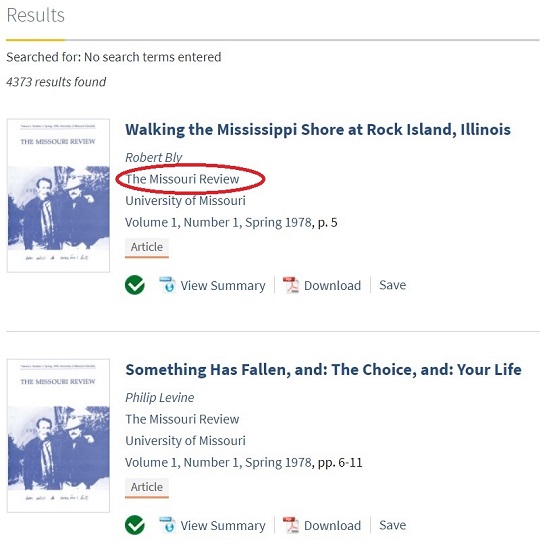
After typing “Missouri Review” in the Journal filter in Step 2, an overwhelming 4,373 results were returned.
To narrow your results, click on the name of the publication (the link) within your Results list.
4.
After clicking on “The Missouri Review” in Step 3, you should get an “About this Journal” screen that provides some background about The Missouri Review.
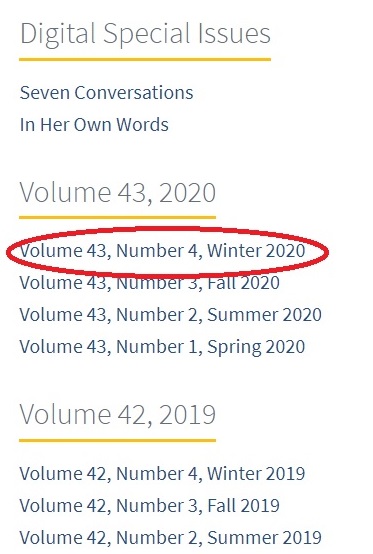
Scroll down on the “About this Journal” page and you’ll see a list of the available volumes and issues of the magazine. If you’re doing market research, you’ll want to look at the most recent issue, which is currently “Volume 43, Number 4, Winter 2020.” Click on the link to the issue you would like to search.
5.
After clicking on the link for the most current issue “Volume 43, Number 4, Winter 2020” in Step 4, you should get an “In this Issue” and “Table of Contents” screen that offers links to the articles within the Winter 2020 issue.
From this Table of Contents screen, you can click on View (to read content online), Download, (to get the pdf file), or Save.
NOTE: Content isn’t often labeled as fiction, nonfiction, or poetry, but the page numbers offer useful clues. A one- or two-page article is more likely to be poetry, and a 10- or 20-page article is likely to be fiction or nonfiction.
Vintage postcard: Night view of the 1933 World’s Fair in Chicago from the sky ride’s observation platform.
Pondering “Giving Tuesday” donation requests and everyday submission fees at lit mags
Writers don’t earn much for publishing their work in literary magazines. In fact, after you add up the online submission fees and the costs of old-school printing and postage, many writers actually pay to have their work published.
However, publishing can build a writer’s social capital. It’s a different type of earning. Publishing is a status symbol, of sorts, that can verify your topic or your writing is good or interesting or digressive or [insert another adjective]. For writing teachers, especially those on the tenure track, publications listed on a vita show a teacher’s relevance and contributions to their field, which helps them get hired or promoted or keeps them employed.
More literary magazines are offering an honorarium beyond “paying” in contributor’s copies and bragging rights. Often honoraria run $25. A few magazines, such as those with commercial or foundation backing, pay professional rates. These mythical outlets may pay $250 to $1,000 or more, but their fiction is liberally sprinkled with agented submissions.
Science fiction, fantasy and other genres
Genre publications, including science fiction and fantasy, seem to take writer’s payments more seriously. Publications can’t be considered professional or “qualifying markets” by the Science Fiction & Fantasy Writers of America unless they pay at least 8 cents per word, among other criteria.
This professionalism goes both ways. Many science fiction, horror, and other genre publications pay their writers, but they may require exclusivity. Their writer’s guidelines may prohibit simultaneous submissions, but in return, they often make their decisions (to publish or not to publish) in days or weeks, rather than months.
SFWA members frown on reading or submission fees. “The Egregious Practice of Charging Reading Fees” is the title of a 2018 SFWA blog by John Walters, a hybrid author who has published more than 20 books. Walters critiques the literary marketplace’s submission fees and their impact on disenfranchisement and diversity.
Poetry has value
As for poetry earnings, think back to the blog “Poetry Has Value” where poets shared monthly tallies of their submission fees and income. For example, Erika Dreifus, author of Birthright: Poems, earned $517.65 from her poetry publications in 2016. However, she did this by pursuing free markets for her poems.
“Thanks to my Poetry Has Value posts, I can tell you that I sent out 134 [packets of] poetry submissions in 2016… Had I spent $3 each time, I’d have shelled out $402 on submission fees. Which would have left me with $117.65,” Dreifus wrote in “Making Poetry Pay: Five Ways to Increase Your Poetry Income,” which was published in The Writer’s Notebook in July 2017.
NOTE: The free monthly Practicing Writer e-newsletter from Erika Dreifus includes “fee-free (and paying) calls and competitions—plus other resources—for writers of fiction, poetry, and creative nonfiction.” More information is at: ErikaDreifus.com
Where is the money in literary publishing?
So, what happens when you follow the money in literary magazine publishing? Like a big shining billboard, there is Submittable.
Submittable, a “submission management software” company based in Missoula, Montana, gives writers an online platform to submit their creative work to publications. Costs for printing, postage, and SASEs (self-addressed stamped envelopes) have morphed into online submission fees. Magazine staff members use the Submittable platform to accept or reject work online. Stacks of mail and full recycling bins have turned into burgeoning electronic queues.
“Since starting, Submittable has partnered with over 11,000 organizations to promote calls, accept, review and take action on over 50 million submissions and applications from over 4.5 million users,” wrote CEO Michael A. FitzGerald in November.
Fifty million submissions…
Some of those submissions were free. Other submissions cost $25-plus. Most of them were about $3. Some of that money went to the publications and some to Submittable. If you read Tahoma Literary Review’s “What We Pay (and how we do it),” you’ll see that in spring 2020 Submittable’s cut of each submission was 5 percent plus 99 cents. This is on top of a yearly fee, which can be $999 for Submittable’s “basic” level.
For Submittable, what does this look like in rough numbers? • 50 million submissions @ $3 apiece = $150 million * 5 percent = $7.5 million • 50 million submissions * 99 cents = $49.5 million • Total: $57 million (This estimate doesn’t include Submittable’s base fees.)
Not bad for a company, originally called Submishmash, that FitzGerald started in his basement with Bruce Tribbensee and John Brownell in 2010.
FitzGerald stepped down as Submittable’s CEO in November 2020 to continue his treatment for colorectal cancer. Thor Culverhouse has since taken over as CEO, but the transition and the recent global recession brought to light hints about the financial side of Submittable. As reported in the Missoulian newspaper:
In July 2019, the company raised $10 million in venture capital.
In April 2020, Submittable laid off 30 of its 130 Missoula-based workers.
I’ll add that, during the pandemic, literary magazine submissions may be up, if the quick closing of metered or free submission windows is any sign.
Why “Giving Tuesday” made me think about this
Even before “Giving Tuesday” I started receiving donation requests from literary magazines that I submitted work to over the years. I don’t mean to put a negative spin on this, but some of these magazines last communicated with me via a boilerplate message like, “Thanks for your submission [and submission fee], but we’re not going to publish your work. We’re so busy that we have nothing more to say right now. Good luck.”
About those $3 submission fees, my math shows: • $1.86 stays with the magazine • $1.14 goes to Submittable Note that it’s not unusual for a higher-tier magazine to receive 10,000 submissions a year.
Nonetheless, I saw a stark contrast. The donation solicitations were annoying, especially those from magazines that hadn’t communicated regularly through newsletters or other avenues. But these literary magazines needed donations, grants, subscriptions, and submission fees to keep publishing. We’re talking about budgets of thousands or tens of thousands of dollars.
Meanwhile, a company that “partnered” with these sometimes-struggling publications talks about fees and venture capital on the order of millions of dollars.
And writers? Maybe they made $500 through their writing last year, if they worked hard and avoided submission fees.
An update from Submittable
Keriann Strickland, director of product & content marketing for Submittable, contacted me to provide additional information about their business and fees. Here’s what she wrote:
First, you caught an error for us; thank you. Michael’s [former CEO Michael FitzGerald’s] blog post should have said nearly 20 million submissions [instead of 50 million].
As the blog you quote mentions, we’ve expanded from our literary roots into many other industries and use cases. That total submission number represents all of those industries/use cases (not just literary journals)—most of them without submission fees.
In the minority case where an organization charges fees, you’re correct that we charge $0.99 + 5% of the total sum collected—4% of that goes to our payment processor (we use a 3rd party for security and compliance standards). More on that break down here: https://www.submittable.com/features/fees-and-payments/
In partnership with CLMP [Community of Literary Magazines and Presses], we also offer special discounted plans for literary journals at $39/month or $290/year (well below our basic pricing https://www.submittable.com/clmp/).
Vintage postcard: Beautiful bridge on Pennsylvania’s Turnpike in the Bedford Narrows.
One of the authors I worked with described his home as “El Rancho Indebto.” That description — from author Daniel Gray’s books, such as Adobe ImageStyler In Depth — has stuck with me even though it has been years since I’ve worked in educational publishing.
Dan had a way of twisting words to make them more interesting amid chapters on how to apply the techniques of web design and develop software expertise. I have to apologize in arrears for probably thwarting some of his descriptions. For example, I remember him writing the lesser-known “stop on a nickel,” and I might have changed it to the tired, old “stopped on a dime.”
In any case, finding the right words, the less tired words, the memorable words, can bring your writing to life. It’s a constant battle I’ve fought by seeking the telling details that deepen scenes.
In my search for the right words, I’ve accumulated a few trusted books that go beyond the thesaurus and Google searches. Books I continue to turn to include:
Random House Word Menu by Stephen Glazier – Struggling to describe the lights and mirrors in a setting? This reference gives you a list, along with short definitions, to help you decide if your setting has a gaslight or a torchiere. A pier glass or a looking glass. See the “Lamps and Mirrors” section.
The Describer’s Dictionary by David Grambs – The subtitle is “A Treasury of Terms & Literary Quotations for Readers and Writers.” Want to give a character a trademark ring or pendant? Scan the “Common Emblems and Symbols” chapter. Consider the implications of whether your character would wear a peaceful ankh (a “loop-topped cross”) or a human skull, “as a symbol of mortality, death’s head, memento mori.” This book is half word lists and half literary excerpts so you can see how authors have employed these details.
DK Ultimate Visual Dictionary – This book is all about images and labels. Want to know the name for that little chute between your character’s nose and lips? A philtrum. (As an aside, some believe the width of this chute is an indicator of a person’s fertility.) Need your character to encounter a horse and touch its leg or head? You might want to know the difference between a fetlock and a forelock. A fetlock is a joint somewhat similar to a human’s ankle, and a forelock is the hair between a horse’s ears that often falls forward like bangs.
Why turn to books when there’s Wikipedia, Google, and other online resources? The more curated content found within these reference books (whether paper or ebook) can save you from falling into a rabbit hole (or as Dan Gray might say, a woodchuck hole) of clicks.
Davis scanned 2,000 books, including bestsellers, prize winners, and books commonly assigned in U.S. high schools and colleges. She used a language processor to see what body parts and adjectives were most commonly used to describe male and female characters. The interactive visual aspects of the Pudding essay allow you to test some of your assumptions about gender and descriptors. (Thank you to Jane Friedman’s “Electric Speed” newsletter for recommending this article.)











 Melissa Olson-Petrie