Vintage postcard: The beach at Oceanside, Calif., from “Views Along the Coast Route between Los Angeles and San Diego.”
Good News: The Spectacle publishes “Scorpion Diary”
My personal essay “Scorpion Diary” has been published by The Spectacle, a literary magazine based at Washington University in St. Louis.
“Scorpion Diary” started as an outline of a boxing-type battle scribbled on napkins at a pizza-by-the-slice shop in 1992. The first drafts focused on the woman versus nature conflict, along the lines of, “Whoa, I lived with scorpions.”
Based on paid feedback from a Tahoma Review editor, revisions incorporated more “woman versus nurture” elements, namely the lasting effects of my mother’s alcoholism. Although I had been researching and drafting pieces about women alcoholics for years, Mom had a rock-wall silent treatment. I knew she wouldn’t understand my need to examine our lives in writing, let alone publish what I’d written. After she died, I restarted my work on this and several related projects.
NOTE: Tahoma Review, Craft, and other literary magazines offer paid feedback and critique options. Prices start at a few extra dollars for the “feedback option” on your submission, which yields a paragraph from a magazine editor. Projects that could benefit from in-depth critiques may cost $50 or more (much, much more). As always, select reputable organizations and editors who work with your type of writing. Beware of editors offering promises of greatness if only you’d send them more money.
Given the years I spent in stealth research mode, especially regarding women alcoholics, my source list for “Scorpion Diary” was long. Present-day websites, such as the “Alcohol Self-Assessment Test” from the National Council on Alcoholism and Drug Dependence, continue to prove helpful given the effects of substance abuse on families and children. My oldest source was a doctoral dissertation on Arizona scorpions from 1939.
The college-instructor frame for “Scorpion Diary” came from chats with two students during a memorable pre-pandemic semester. One student felt she had to choose between supporting her alcoholic mother or pursuing her own goals to get an education and career. Another student was in crisis about how to get through the semester while keeping his family housed. I recognized the parental roles both students took on, complete with the burdens of guilt and Sisyphean responsibilities.
A major revision took “Scorpion Diary” (as well as “Handwashing Dishes,” which was published by Southeast Review) into second-person (you) point of view. Second-person POV helped me navigate glitchy passages that wanted to shift between first-person insights and third-person reportage. Second person offered a balance between emotional distance and experiential immediacy that conveyed more than I ever thought I could back when I was writing on those pizza-place napkins.
Vintage postcard: Chicago, Minneapolis & St. Paul Railway Depot, Stoughton, Wisconsin.
Lit-mags lose when colleges and universities consolidate, cut back or close
Sometimes campus mergers in higher education can result in orphaned or abandoned literary magazines. More lit-mags may become unresponsive or inactive as colleges and universities continue to consolidate, cut back, or close.
Example: University of Wisconsin System mergers
A decade ago, many of Wisconsin’s 26 state universities and colleges had literary magazines.
Wisconsin had 13 four-year state universities and 13 state-run two-year colleges (separate from technical and private colleges).
Today, several of those literary magazines (most often from two-year colleges) are no longer publishing after a shuffling and reshuffling of campuses.
Two rounds of mergers brought Wisconsin’s two-year colleges under the umbrellas of nearby four-year state universities. The UW System now describes itself as, “13 universities across 26 campuses…”
Case study #1: Luce
Luce was the literary magazine at the University of Wisconsin-Sheboygan (a two-year college). When the UW System reorganized and then reorganized yet again, UW-Sheboygan became UW-Green Bay’s Sheboygan Campus. In other words, UW-Sheboygan became part of a four-year university. However, UW-Green Bay already had its own literary magazine, SheepsheadReview, and Luce faded away (at least for now).
Elsewhere in the UW System, other college lit-mags may not have survived campus mergers or related changes, including:
The Windy Hill Review at UW-Waukesha (now UW-Milwaukee at Waukesha County)
Fox Cry Review at UW-Fox Valley (now UW-Oshkosh, Fox Cities Campus)
Mush Literary Magazine at UW-Marathon County (now UW-Stevens Point at Wausau)
Rock River Review, at UW-Rock County (now UW-Whitewater at Rock County)
Others?
No longer anyone’s job
Mergers are often made in the name of cost-cutting. In higher-ed mergers, almost all university employees see their jobs change. The faculty members or university staff who advised or managed literary magazines usually see new (or modified) work assignments, as well as increased workloads. These job changes may not include their previous lit-mag work.
Supposed redundancies
Administrators hunt down opportunities for cost savings in any campus merger. It’s not hard to guess their reactions upon realizing that after a merger they have not only one lit-mag to support, but maybe two or three more as well. Chop! Mergers and “redundancies” don’t mix.
What’s a writer to do?
On their websites and Submittable listings orphaned or abandoned university lit-mags may appear to be operating with business as usual. Information about behind-the-scenes staffing and funding changes may not be announced.
As always, writers should look for proof of life, so to speak, such as updated website content and recent publications. Also, check out Duotrope and other sources of literary marketplace information.
Even after doing their research, writers may discover that they’ve submitted work to a university lit-mag that has gone silent. No responses. No publications. Nothing.
What about submissions and fees?
Note that some orphaned lit-mags may continue accepting submissions and submission fees. My sense is that this is an oversight (not intentional), at least for university publications. And I hope refunds would be arranged.
For what it’s worth, major scheduling and staffing changes in higher ed often occur during the lull between academic years, namely in the summer. A magazine’s faculty adviser or manager may end an academic year with the publication of a magazine they hope won’t be their last. By the time fall rolls around, the class or the program or the paid jobs that supported that literary magazine may be gone. Who’s left to mind the lit-mag when the paid staff’s gone and the student workers have likely graduated or moved on with their degree programs?
Case study #2: Green Mountains Review
The home campus of Green Mountains Review used to be Northern Vermont University. Currently, the NVU website leads with, “We’re Now Vermont State University!” This points to yet another campus merger.
As a writer, I’ve had a manuscript “in progress” at Green Mountains Review since February 2022. I discovered the university’s name change/merger info when checking to see what was going on at the lit-mag. In other words, I was wondering about the lag, especially upon seeing their website’s last news item was from November 2022.
I’m not alone in wondering about Green Mountains Review, according to a recent Lit Mag News article “Who holds lit mags accountable?” by Becky Tuch. She asks useful questions about who is accountable for unresponsive or inactive lit-mags, especially when submission fees are involved, such as the $3 that Green Mountains Review had collected for each submission until recently.
In today’s environment of increased university cuts, the tally of orphaned or abandoned lit-mags may continue to grow, reducing opportunities for writers, editors, designers, readers, and more.
Vintage postcard: Forest Drive, Near Observatory Tower, Peninsula State Park, Door County, Wisconsin.
For some reason, meeting writing goals and finishing projects seem more difficult these days.
What’s getting in the way of your writing?
Is it the specter of AI replacing you as a writer? Or fears that AI could copy, replicate, and surpass your writing, as has happened to some visual artists?
How about the publications (markets) you’ve been watching that closed to submissions while they figure out how to handle all the AI-generated stuff?
Is it the revelations about contests/lit mags/publishers that continue to accept submissions (and fees) but never publish anything or much of anything?
Have you received just one rejection too many?
Is it that life is getting back to normal, and suddenly there’s so much to do (besides writing) now that lockdowns are in the rearview?
Is it just summer?
Is it just me?
Setting writing goals, seeking inspiration, and addressing common frustrations seem to help. Or at least they sound good. Here are a few resources for writers:
1. 1000 Words of Summer
In her Poets & Writers Magazine article, “1000 Words of Summer: How an Accountability Project Opened Up My Writing Life,” Jami Attenberg discusses how a now-worldwide project started, “In 2018 my friend Anne Gisleson and I decided to write a thousand words a day, every day, for two weeks straight.” The #1000wordsofsummer project’s sixth year started on June 17, 2023, and Attenberg has been posting daily on her Craft Talknewsletter, as well as on Instagram and Twitter. Even if you’re starting this project late, there’s still time to read the newsletters and get a writerly boost.
2. Field Trips for Serendipity & Inspiration
Maybe you feel like you don’t have time to peruse a book or take a field trip, but maybe you’ll find information you need (a key, an inspiration) from an unexpected source. What book or artwork or object practically jumps out at you? Here are a few places that might coax creativity your way:
The recent releases shelf at your local library. What catches your eye? How might a source connect to your works in progress?
Museums, galleries, resale shops, flea markets, and more. Again, what are you drawn to? Ask yourself what the visuals, objects, and their histories could contribute to your writing. Maybe do some people watching too. For instance, I once saw a goateed woman haggling with a burly vendor over sewing notions at a swap meet.
Immersion in tastes, smells, and sounds. Indulge your senses at spice shops, confectionaries, farmer’s markets, ethnic restaurants, neighborhood sporting events, music recitals, and more. Sometimes just listening to buildings—the different sounds inside a high-rise and a hospital—can alert you to telling details for your writing.
3. Websites for Writers
Moderation (avoiding rabbit holes) is important, especially with websites, but sometimes hearing what other writers are saying is reassuring:
Writer Unboxed: This website “is dedicated to publishing empowering, positive, and provocative ideas about the craft and business of fiction… [T]he site now hosts more than 50 contributors, including bestselling and rising authors and industry professionals.”
Writer’s Digest’s 101 Best Websites for Writers: Past categories have included: Best Live Streams, Podcasts, and YouTube Channels for writers; Best Writing Advice Websites (including Writer Unboxed); and Best Genre/Niche Websites. The 2022 list came out in July, so the 2023 listings should be published soon.
In the end, doing something (anything short of a bonfire) with your writing is more productive than the alternative, right?
“[Tillie] Olsen makes the case that women writers have faced crushing odds, their talents underestimated, their achievements ignored, the themes of their writing scorned, their very attempt to write condemned as a breach of family duty — and of feminine nature. And yet, as she shows, they have written.” This quote, from the back cover of the 25th anniversary edition of Silences, helps place author Tillie Olsen’s (1912-2007) book in perspective.
I reread Silences for Women’s History Month (March) and was appalled by the treatment many women writers have had to endure.
I hadn’t fully appreciated Olsen’s points when I first read Silences in grad school. The annotations in the anniversary edition helped, but so did years of reading many of the authors Olsen quotes, including Margaret Atwood, Willa Cather, Virginia Woolf, Emily Dickinson, and others.
Today, drawing on years of reading, writing, and submitting works for publication — all while trying to balance work and family life — I have the context needed to better understand the book Olsen first published in 1978.
‘The themes of their writing scorned’
In Olsen’s chapter on the “Sense of Being Wrong Voiced,” I circled the quote, “There is a wide discrepancy in American culture between the life of women as conceived by men and the life of women as lived by women,” which Olsen attributes to historian Lillian Schissel, editor of Women’s Diaries of the Westward Journey.
Back in the day, I don’t remember connecting Olsen’s points about women writers and women’s lives to the work I was doing with my MFA peers and professors, but I probably should have. Upon rereading Silences, some interactions came to mind, such as…
“Nothing happens.”
Although the statement is decades old, I remember who said it. I can still see him in the yellow light of the basement classroom at our Arizona university. Behind him, our instructor (who recommended Silences) seemed like an out-of-reach lifesaver as she chatted with another student critique group.
My peer had dismissed my fiction draft quickly and concisely because, according to him, “nothing happens.” As far as he was concerned, his critique of my story was complete. But we still had almost an hour to fill in our graduate long-form short story workshop. Finally, he asked, “If she wanted a drink, why didn’t she get on the casino bus with the rest of them?”
Why, indeed.
This peer’s question reminded me of a professor’s feedback on that same writing project: “An alcoholic would drink vodka, not whiskey.” His reasoning involved avoiding detection and costs, since I had specified a female character’s preference for Jack Daniels, her father’s favorite.
‘I speak of myself to bring here the sense of those others to whom this is in the process of happening (unnecessarily happening, for it need not, must not continue to be) and to remind us of those (I so nearly was one) who never come to writing at all.’ –Tillie Olsen, Silences
Apparently, I knew nothing about alcoholics — at least not their tropes of preferring cheap booze, acting out, and so on. But maybe it was just that I didn’t appreciate the clichés surrounding alcoholics? While “good” writers are supposed to avoid clichés in their sentences, shouldn’t they also avoid clichéd tropes in their characters?
I entered both critiques knowing my work-in-progress needed significant revision. The drafts focused on three generations of women and, by extension, the women’s circles of their church as they dealt with the alcoholism of one of their own. But to just dismiss the project as “nothing happens”? To “correct” details when the entire project was still in development?
Both interactions were frustrating. My peer’s underlying message: “Give it up.” The professor’s: “You don’t know what you’re writing about.” (I’m sure my professor offered more useful feedback, but his correction had the lasting impact.) I remember feeling that my work wasn’t being considered seriously. In rereading Silences, I realized (unfortunately) that I wasn’t alone.
‘One Out of Twelve’
“One Out of Twelve” is a rallying point in Silences. Olsen points out that in the literary canon, one in twelve (or less) are works by women writers. Same for publications, awards, anthologies, and more when Olsen’s book was published in 1978.
In the late 1990s, the literary landscape looked a bit better, based on my MFA comprehensive fiction reading list. The readings included 37 women authors among 113 fiction works listed or an improved ratio of about one out of three.
Today, the gatekeepers for publications, awards, and reviews could still do better. Voices silenced — women’s voices, LGBTQ+ voices, POC voices, differently abled voices, etc. — can mean missed understandings and lost connections.
The conversation about the challenges facing women writers continues. If you’re interested in reading more, check out:
Novelist Meg Wolitzer’s New York Times article — “The Second Shelf: From covers to marketing to awards, why do novels by women get different treatment than books by male authors? In 2012, Meg Wolitzer took on the elephant in the library” — was republished on Oct. 21, 2021, and is available at: https://www.nytimes.com/2021/10/21/books/meg-wolitzer-second-shelf.html (Note: The New York Times usually offers a few free article views a month.)
Novelist and essayist Jennifer Weiner blogs about the New York Times poor track record of reviewing fiction by women at: http://jenniferweiner.blogspot.com/2010/09/back-in-august-when-jodi-picoult.html The blog post dates back to Sept. 21, 2010, but has the representation of women authors among Times (and other) reviews changed much?
Vintage postcard: Aquarium, Belle Isle, Detroit, Michigan.
The literary magazine universe doesn’t need to be this way:
Editors frustrated by an avalanche of manuscripts that are wildly inappropriate for their publication’s audience, mission, or market. Mismatched texts clog their submission portals, consume their time, and leave them so cranky that when they actually find a promising text, they may be too tired or frustrated to acknowledge it.
Writers clueless as to why they’re being rejected again, and again, and again. The whole submission process begins to feel like throwing darts at balloons in some literary carnival game. Merely a word or three of feedback from an exhausted editor feels like a win.
Readers struggling to understand what makes one literary magazine different from another. For example: Which literary magazine is sure to offer eco-fiction and eco-poetry? Which magazine tends to provide eye-opening perspectives from X community?
These types of misalignments aren’t unique to the publishing world. In teaching, an instructor may fail to communicate how course learning outcomes align with class activities. Think back to times when you were unpleasantly surprised about what was on a test. In business, an inept manager may harp on minutia (such as using envelopes that cost 8 cents vs. 9 cents apiece) while rewarding only mission-related work with year-end raises.
Both teachers and managers, should look at themselves first when they don’t receive what they want in terms of performance. The same can be said for lit mags and their editors.
What is a lit mag (short for literary magazine)?
Wikipedia offers the following, “A literary magazine is a periodical devoted to literature in a broad sense. Literary magazines usually publish short stories, poetry, and essays, along with literary criticism, book reviews, biographical profiles of authors, interviews and letters. Literary magazines are often called literary journals, or little magazines, terms intended to contrast them with larger, commercial magazines.”
Wikipedia includes a brief history of literary magazines, as well as a link to a “List of literary magazines.” Also see writer Clifford Garstang’s helpful 2022 Literary Magazine Ranking, a yearly compilation he bases on Pushcart Prize results.
Communication can be the key to reducing the churn in literary magazine submissions. Unfortunately, mission statements and “About Us” webpages are often vague, such as “We want to publish the best fiction, poetry, and creative nonfiction available.” What does “best” mean? Each staff member may approach or define “best” differently.
Subgenre overload
Market listings for literary magazines — whether in Submittable, Duotrope, annual Writer’s Market books, or elsewhere — often push editors to offer more specifics about what they want to publish. This can be useful. However, such listings may also exacerbate miscommunication, especially in regard to subgenres. How much do you know about a lit mag that says it publishes a laundry list of subgenres?
For example, the Poets & Writers literary magazine database lists 38 potential subgenres, and recently a reputable Midwestern literary magazine designated 32 of them and excluded only six:
Autobiography/memoir
BIPOC voices
Commercial fiction
Creative nonfiction
Cross-genre
Erotica
Experimental
Feminist
Fiction
Flash fiction
Formal poetry
Graphic/illustrated
Graphic/health
Historical
Humor
Journalism/investigative reporting
LGBTQ voices
Literary fiction
Love
Lyric essay
Micro-poetry
Narrative nonfiction
Nature/environmental
Nonfiction
Poetry
Political
Pop culture
Prose poetry
Regional
Religious/spiritual
Serialized fiction
Short fiction
Speculative fiction
Speculative poetry
Translation
Visual poetry
War
Young adult
How much does a list of 32 subgenres tell writers, readers, or even staff members about a lit mag? From the editorial side, the rationale may be to keep options (or subgenres) open. But writers have likely responded with a raft of everything-goes submissions.
On the plus side, broad mission statements or subgenre lists offer flexibility for a magazine’s management, especially for college and university publications that change editors yearly. However, the outside view of vague descriptions or jargony missions is that the publication’s editorial targets are constantly shifting.
An unfortunate result is that the common advice to read a magazine to familiarize yourself with what it publishes often doesn’t work with the broad missions and shifting staffs of some publications. For example, one year a lit mag editor may include mermaid and ghost stories, but editors in previous and following years may reject such stories at the first hint of merpeople or specters.
Theme issues
Theme issues or special sections may be useful for editors, writers, and readers facing unclear or outdated mission statements.
Some publications, such as Fairy Tale Review, set a theme for each issue. Other magazines, such as Creative Nonfiction, intersperse theme and “regular” issues. When editors communicate their themes they often offer more information and details that help writers align and target their submissions.
A couple examples of upcoming theme issues (and their deadlines) include:
Creative Nonfiction. Theme: “Caring for the Heart.” Deadline 1/23/2023. “For an upcoming issue, Creative Nonfiction is seeking new narratives about caring for the heart — medically, technologically, or metaphorically. We’re looking for stories from healthcare workers and researchers; counselors and cardiologists and coaches; nurses and nutritionists … or any red-blooded writer with a heart.” See Creative Nonfiction’s website to continue reading the submission call.
Fiction International. Theme: “Refugee.” Deadline: 2/16/2023. “Fiction, non-fiction, and indeterminate prose texts of up to 5,500 words that address the theme of ‘Refugee’ are welcome. We will consider submissions of narrative, anti-narrative and indeterminate texts but only accept submissions reflecting the theme.…” See Fiction International’s Submittable listing for more information, as well as a link to the magazine’s catalog, which might offer insights into “indeterminate texts.”
Vintage postcard: General Motors Building, Chicago World’s Fair, 1933.
Start with the acknowledgment pages
If you read the acknowledgment pages of many novels, nonfiction books, short story collections, and poetry books, you’ll often see where earlier excerpts were published. This can tell you several things, including that the publications listed:
May be something you would like to read
May be markets for your own work
Often, first publications or excerpts appear in literary magazines. If you’re working on your own book or collection, literary magazines may be an important step in your reading, researching, and publishing journey.
For example, in World of Wonders: In Praise of Fireflies, Whale Sharks, and Other Astonishments, Aimee Nezhukumatathil’s 2020 book, the acknowledgments include literary magazines such as Brevity, Diagram, Ecotone, and Georgia Review.
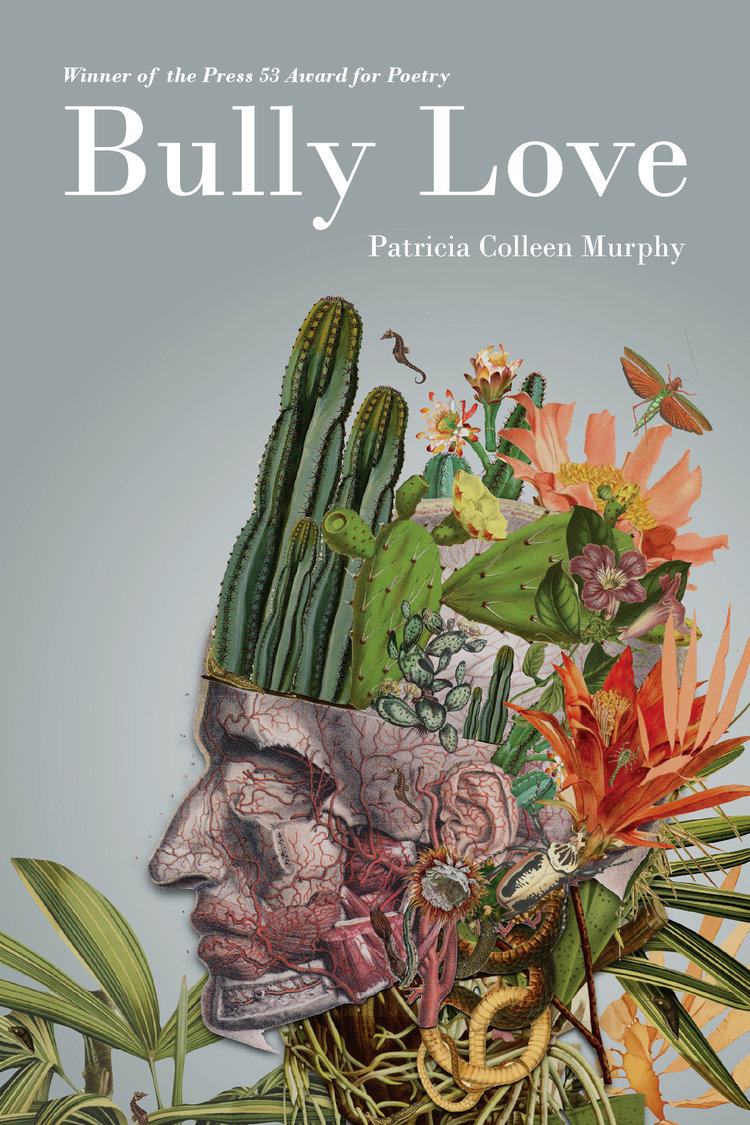
Bully Love, Patricia Colleen Murphy’s 2019 poetry collection, lists acknowledgments for Hawaii Review, Heliotrope, Indiana Review, and many other publications.
Finding literary magazines
Finding information about the literary magazines listed on an acknowledgments page is an online search away. However, reading the stories, poems, and essays they publish can get tricky. The spectrum of literary magazines ranges from fully online to print-only magazines that publish zero content online.
Reading content
Reading online literary magazines can be as easy as signing up on their websites, but reading print-based magazines may involve ordering print or electronic copies of individual issues. Some magazines offer pdf versions of recent back issues that may be available for reduced prices and quick access.
Don’t skimp on reading. An important part of the submission process is familiarizing yourself with individual literary magazines. Research what they’ve published. A friend of mine from grad school didn’t do this, and he ended up with a publication that he finds embarrassing to this day.
Submitting work
Submission windows for literary magazines may vary from one week to year-round. A few don’t accept any unsolicited work. Tactics to find these submission windows and writers’ guidelines start with a magazine’s website. If the magazine offers a newsletter, sign up to receive alerts about content, contests, submissions, blog posts, and (yes) fundraising.
Another tactic to find submission windows and guidelines is to “follow” publications in Submittable, an online submission management platform. Once you follow a publication, you’ll build a dashboard-like “Following” screen within Submittable that you can skim for “opportunities.” Some of these opportunities are solicitations to buy copies of magazines, but the majority are submission portals for fiction, poetry, creative nonfiction, comics, plays, contests, and more.
Setting your intentions
Many writers set quotas for themselves when drafting or sending out work. However, fewer writers seem to set reading quotas, such as to explore one new literary magazine each week. Or push your weekly reading to include at least one short story, essay, or set of poems from a literary magazine.
This intentional exploring and reading of literary magazines can yield inspiration, which contributes to your writing, revising, and submissions process. You’ll also gather valuable information about the literary marketplace, including where to find copacetic writers and editors.
For help, check out “Resolve to read a literary magazine,” a recent effort by the Community of Literary Magazines and Publishers. Click through the CLMP membership directory for reading and submission options as well as discount subscription bundles.
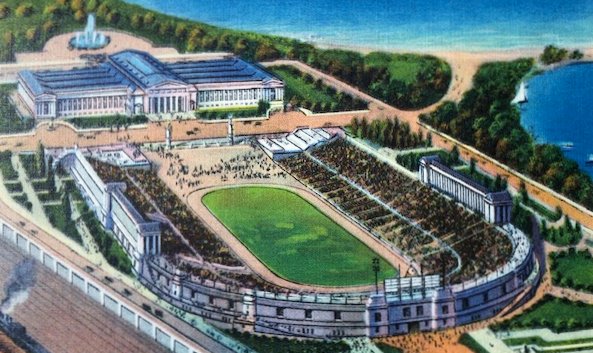
Vintage postcard: Soldiers Field & Field Museum at the Chicago lakefront.
Miss those fiction workshop critiques of other writers’ work? Maybe? I remember having a lot of time to doodle in MFA workshops, especially when the conversations turned contentious. Then, moments of constructive feedback would connect to my own writing and lead to furious notetaking.
Reminiscent of the best graduate school critique sessions, the following three blog series offer insights into the craft of fiction writing. We have the added knowledge that whatever worked (or not) in the stories has resulted in publication.
In monthly posts on Writer Unboxed, Ray Rhamey provides a novel’s first 17 lines and asks “Would you pay good money to read the rest of the chapter?” And, by extension, would you be willing to risk money and time to read the book, especially if you were a busy literary agent?
After the novel’s opening lines, Rhamey shares his verdict, explains his reasoning, and polls blog readers for their verdicts and comments. Reader comments, along with Rhamey’s own, offer useful perspectives into storytelling choices and their consequences. The series has examined books by Elin Hilderbrand, Kristin Hannah, Stephen King, and John Grisham, among others. The outcomes can be surprising, especially when the writing of a well-known novelist doesn’t conform to commonly held writing advice. (Note: The opening of Stephen King’s most recent novel didn’t fare as well as you might think.)
Ray Rhamey offers the opportunity for writers to receive similar feedback on their works in progress through his Flogging the Quill blog. Rhamey is the author of five nonfiction books, including Mastering the Craft of Compelling Storytelling, and four novels in genres such as political thrillers and contemporary fantasy.
“Let’s Deconstruct a Story: A Podcast for the Story Nerds” is a series of podcasts and blog posts that include author interviews conducted by Kelly Fordon, who teaches writing in the Detroit area and has published two short story collections and a poetry collection.
August’s post featured an interview with Susan Perabo about her story “This Is Not That Story,” which appeared in The Sun in March 2006. Perabo, whose most recent book is They Run the Way They Do, ended the interview by saying, “I love getting into the choices and the questions that only deep reading and deep thinking can get you to. I think you’re doing a great service for writers and for students of writing, and that’s all of us, right?”
As with all critique sessions, you should read the story first, and Fordon provides links to the texts under discussion. Her posts often go beyond the basics. For example, in a deconstruction of the story “Creve Coeur” by Jacob M. Appel, Fordon created a word cloud from the adjectives Appel used. It’s telling that the words “dark” and gray” stand out, as do the words “indifferent” and “happy.”
NOTE: Beyond deconstructing someone else’s story, creating a word cloud for your own work can be a useful editing and revision tool for exploring a story’s tone and the ideas or themes being explored.
“I’m basically offering these workshops on ‘Let’s Deconstruct a Story’ for my own gratification because I feel like I learn so much from studying the stories of other writers,” says Fordon at the beginning of her work with Appel’s short story. “Really delving into them. Seeing how they work, the mechanics, so I can get some more tools for my own toolbox.”
The Kenyon Review’s blog includes the occasional feature “Why We Chose It” written by the literary magazine’s fiction and nonfiction editors. Posts in the series link to a current selection from the Kenyon Review so that you can read the text being discussed. For veterans of lit-mag rejections, the posts offer insight into what drew an editor to a particular story.
In a recent “Why We Chose It” post, the Kenyon Review’s Sergei Lobanov-Rostovsky focuses on the short story “Caduceus” by Perry Lopez, which appeared in the magazine’s July/August 2021 issue. Kenyon Review is published six times a year at Kenyon College in Gambier, Ohio.
Vintage postcard: United States-Mexico boundary line near Tijuana, Mexico.
At least two print-based literary magazines have opened up their recent issues for online reading during the pandemic:
Ecotone issues 25, 26, 27, and 28 (their most recent issue) are free to read online “throughout the pandemic.” To start reading, go to: https://ecotonemagazine.org/magazine/
The Missouri Review’s content is available online through the Project Muse database until the end of March. (See the tech note below, to help you navigate Project Muse.)
Print-based literary magazines don’t seem to share much of their content online, so these opportunities are worth checking out.
Magazines offering full-text content through Project Muse
Here are seven lit-mags, including The Missouri Review for now, that continue to offer full-text content from their recent issues through Project Muse:
Manoa: A Pacific Journal of International Writing (University of Hawai’i Press)
1999 to present
2020 (Vol. 32, No. 2)
Note that database content can change quickly. In other words, due to budgets, contract negotiations, and legal and financial wrangling, publications can pop into and out of Project Muse and other databases. What you were looking at yesterday, might not be there today.
For my students, I recommend they download any database document (including bibliographic information) if they even think it might be useful in their work. Note that these downloads are for personal use only.
About Project Muse
Project Muse is an online database available through many college and university libraries. The database offers access to articles, poems, fiction, nonfiction, and other content published by a variety of journals, including select literary magazines.
In terms of market research, database access to full-text content is valuable because once you’ve read what a magazine is publishing, you can sense whether your writing might find a home there. Also, it never hurts to mention a memorable piece you read from the editor’s magazine when writing a cover letter.
TECH NOTE: How to search the Project Muse database
Databases offer multiple points of access, but the following is the quickest way I’ve found to search for and read content from the magazines listed above using Project Muse.
1.
Select “Project Muse” from the list of databases available on your college or university library’s website.
2.
Instead of using the search box at the top of the screen, scroll down to find the “Journal” filter on the left side of your screen. Enter “Missouri Review” in the Journal filter.
NOTE: Skip the “Content Type” filter, which starts a much broader search related to journals.
3.
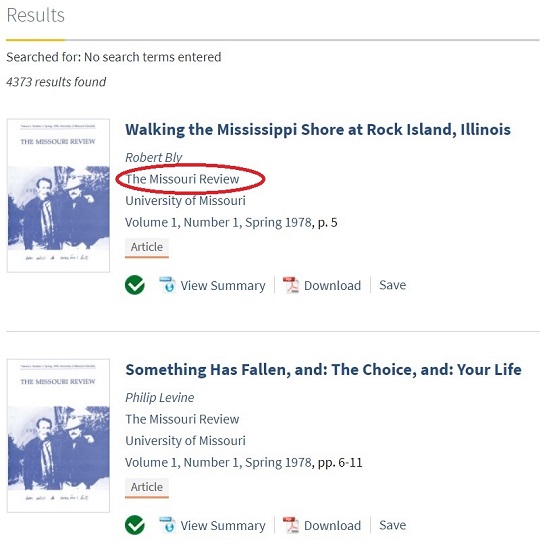
After typing “Missouri Review” in the Journal filter in Step 2, an overwhelming 4,373 results were returned.
To narrow your results, click on the name of the publication (the link) within your Results list.
4.
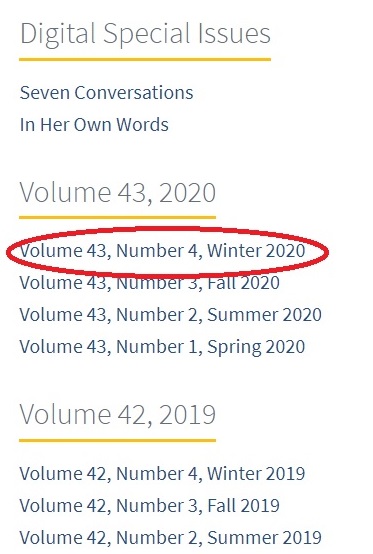
After clicking on “The Missouri Review” in Step 3, you should get an “About this Journal” screen that provides some background about The Missouri Review.
Scroll down on the “About this Journal” page and you’ll see a list of the available volumes and issues of the magazine. If you’re doing market research, you’ll want to look at the most recent issue, which is currently “Volume 43, Number 4, Winter 2020.” Click on the link to the issue you would like to search.
5.
After clicking on the link for the most current issue “Volume 43, Number 4, Winter 2020” in Step 4, you should get an “In this Issue” and “Table of Contents” screen that offers links to the articles within the Winter 2020 issue.
From this Table of Contents screen, you can click on View (to read content online), Download, (to get the pdf file), or Save.
NOTE: Content isn’t often labeled as fiction, nonfiction, or poetry, but the page numbers offer useful clues. A one- or two-page article is more likely to be poetry, and a 10- or 20-page article is likely to be fiction or nonfiction.
Vintage postcard: Night view of the 1933 World’s Fair in Chicago from the sky ride’s observation platform.
Pondering “Giving Tuesday” donation requests and everyday submission fees at lit mags
Writers don’t earn much for publishing their work in literary magazines. In fact, after you add up the online submission fees and the costs of old-school printing and postage, many writers actually pay to have their work published.
However, publishing can build a writer’s social capital. It’s a different type of earning. Publishing is a status symbol, of sorts, that can verify your topic or your writing is good or interesting or digressive or [insert another adjective]. For writing teachers, especially those on the tenure track, publications listed on a vita show a teacher’s relevance and contributions to their field, which helps them get hired or promoted or keeps them employed.
More literary magazines are offering an honorarium beyond “paying” in contributor’s copies and bragging rights. Often honoraria run $25. A few magazines, such as those with commercial or foundation backing, pay professional rates. These mythical outlets may pay $250 to $1,000 or more, but their fiction is liberally sprinkled with agented submissions.
Science fiction, fantasy and other genres
Genre publications, including science fiction and fantasy, seem to take writer’s payments more seriously. Publications can’t be considered professional or “qualifying markets” by the Science Fiction & Fantasy Writers of America unless they pay at least 8 cents per word, among other criteria.
This professionalism goes both ways. Many science fiction, horror, and other genre publications pay their writers, but they may require exclusivity. Their writer’s guidelines may prohibit simultaneous submissions, but in return, they often make their decisions (to publish or not to publish) in days or weeks, rather than months.
SFWA members frown on reading or submission fees. “The Egregious Practice of Charging Reading Fees” is the title of a 2018 SFWA blog by John Walters, a hybrid author who has published more than 20 books. Walters critiques the literary marketplace’s submission fees and their impact on disenfranchisement and diversity.
Poetry has value
As for poetry earnings, think back to the blog “Poetry Has Value” where poets shared monthly tallies of their submission fees and income. For example, Erika Dreifus, author of Birthright: Poems, earned $517.65 from her poetry publications in 2016. However, she did this by pursuing free markets for her poems.
“Thanks to my Poetry Has Value posts, I can tell you that I sent out 134 [packets of] poetry submissions in 2016… Had I spent $3 each time, I’d have shelled out $402 on submission fees. Which would have left me with $117.65,” Dreifus wrote in “Making Poetry Pay: Five Ways to Increase Your Poetry Income,” which was published in The Writer’s Notebook in July 2017.
NOTE: The free monthly Practicing Writer e-newsletter from Erika Dreifus includes “fee-free (and paying) calls and competitions—plus other resources—for writers of fiction, poetry, and creative nonfiction.” More information is at: ErikaDreifus.com
Where is the money in literary publishing?
So, what happens when you follow the money in literary magazine publishing? Like a big shining billboard, there is Submittable.
Submittable, a “submission management software” company based in Missoula, Montana, gives writers an online platform to submit their creative work to publications. Costs for printing, postage, and SASEs (self-addressed stamped envelopes) have morphed into online submission fees. Magazine staff members use the Submittable platform to accept or reject work online. Stacks of mail and full recycling bins have turned into burgeoning electronic queues.
“Since starting, Submittable has partnered with over 11,000 organizations to promote calls, accept, review and take action on over 50 million submissions and applications from over 4.5 million users,” wrote CEO Michael A. FitzGerald in November.
Fifty million submissions…
Some of those submissions were free. Other submissions cost $25-plus. Most of them were about $3. Some of that money went to the publications and some to Submittable. If you read Tahoma Literary Review’s “What We Pay (and how we do it),” you’ll see that in spring 2020 Submittable’s cut of each submission was 5 percent plus 99 cents. This is on top of a yearly fee, which can be $999 for Submittable’s “basic” level.
For Submittable, what does this look like in rough numbers? • 50 million submissions @ $3 apiece = $150 million * 5 percent = $7.5 million • 50 million submissions * 99 cents = $49.5 million • Total: $57 million (This estimate doesn’t include Submittable’s base fees.)
Not bad for a company, originally called Submishmash, that FitzGerald started in his basement with Bruce Tribbensee and John Brownell in 2010.
FitzGerald stepped down as Submittable’s CEO in November 2020 to continue his treatment for colorectal cancer. Thor Culverhouse has since taken over as CEO, but the transition and the recent global recession brought to light hints about the financial side of Submittable. As reported in the Missoulian newspaper:
In July 2019, the company raised $10 million in venture capital.
In April 2020, Submittable laid off 30 of its 130 Missoula-based workers.
I’ll add that, during the pandemic, literary magazine submissions may be up, if the quick closing of metered or free submission windows is any sign.
Why “Giving Tuesday” made me think about this
Even before “Giving Tuesday” I started receiving donation requests from literary magazines that I submitted work to over the years. I don’t mean to put a negative spin on this, but some of these magazines last communicated with me via a boilerplate message like, “Thanks for your submission [and submission fee], but we’re not going to publish your work. We’re so busy that we have nothing more to say right now. Good luck.”
About those $3 submission fees, my math shows: • $1.86 stays with the magazine • $1.14 goes to Submittable Note that it’s not unusual for a higher-tier magazine to receive 10,000 submissions a year.
Nonetheless, I saw a stark contrast. The donation solicitations were annoying, especially those from magazines that hadn’t communicated regularly through newsletters or other avenues. But these literary magazines needed donations, grants, subscriptions, and submission fees to keep publishing. We’re talking about budgets of thousands or tens of thousands of dollars.
Meanwhile, a company that “partnered” with these sometimes-struggling publications talks about fees and venture capital on the order of millions of dollars.
And writers? Maybe they made $500 through their writing last year, if they worked hard and avoided submission fees.
An update from Submittable
Keriann Strickland, director of product & content marketing for Submittable, contacted me to provide additional information about their business and fees. Here’s what she wrote:
First, you caught an error for us; thank you. Michael’s [former CEO Michael FitzGerald’s] blog post should have said nearly 20 million submissions [instead of 50 million].
As the blog you quote mentions, we’ve expanded from our literary roots into many other industries and use cases. That total submission number represents all of those industries/use cases (not just literary journals)—most of them without submission fees.
In the minority case where an organization charges fees, you’re correct that we charge $0.99 + 5% of the total sum collected—4% of that goes to our payment processor (we use a 3rd party for security and compliance standards). More on that break down here: https://www.submittable.com/features/fees-and-payments/
In partnership with CLMP [Community of Literary Magazines and Presses], we also offer special discounted plans for literary journals at $39/month or $290/year (well below our basic pricing https://www.submittable.com/clmp/).
Patricia Colleen Murphy founded Superstition Review at Arizona State University, where she teaches creative writing and magazine production. Her book Bully Love (Press 53) won the 2019 Press 53 Award for Poetry and was published in 2019. Her book Hemming Flames (Utah State University Press) won the 2016 May Swenson Poetry Award, judged by Stephen Dunn, and the 2017 Milt Kessler Poetry Award. A chapter from her memoir in progress was published as a chapbook byNew Orleans Review. Her writing has appeared in many literary journals, including The Iowa Review, Quarterly West, American Poetry Review, and has received awards from Gulf Coast, Bellevue Literary Review, among others. She lives in Phoenix.
How would you describe your poetry collection in 2-3 sentences (as a novelist or screenwriter might offer in an elevator speech)?
This book examines how location informs identity, loss, and love. With images drawn from a difficult childhood in Ohio, and a subsequent rebirth in the wildest areas of Arizona, Bully Love delivers a portrait of one woman’s struggle to make sense of disappointments caused by both people and places.
Which poem did you most enjoy writing? Why? Also, which poem gave you the most trouble, and why?
My favorite poem in the collection is “Plucked.” I enjoy the whimsy of the opening, which contrasts with the content later in the poem: the tragedy of my mother’s mental illness. I wrote this poem after a hike in the desert during which I was feeling very emotional. That is usually how a poem starts for me, with a strong emotion. The images in the poem presented themselves in order and on time. And that is a true blessing! Because so often that does not happen. The poem also served an important purpose in the collection as a whole, by showing a strong reason why I wanted to escape Ohio, and what the desert offered instead.
By far the hardest to write was the poem with the title in its last line: “Day Trip, Cave Creek Guided Tours.” The poem describes a ride my girlfriends and I took with a typical Cowboy Wrangler Outfitter. The activity is designed to delight tourists and let them dip into a culture few of them care about. The line in the poem that includes the title describes the horses as, “quietly suffering our pats of bully love.”
My editor, Tom Lombardo, nudged me to make that theme more clear and more relevant to the collection as a whole. I think I sent him something like six versions of the poem. I had such a hard time getting it right. But then one day I realized, my god I’m one of those horses. My mother used me as a means to an idealized end. She wanted me to be perfect, part of a package that suited her and others. I got next to no pats from her, and those I received were insincere.
You’re the founding editor of Superstition Review, an online literary magazine, and you’ve been a poetry editor for Hayden’s Ferry Review. Could you share your insights on how the arena of literary magazines and publishing is evolving, especially for poetry?
It is my observation that many literary magazines are currently reaching for out-of-the-box content and forms. One way I measure this is by looking at Poem-A-Day from the Academy of American Poets. That’s pretty much the first thing I do each day is read the poem in the newsletter. This year new poets are curating each month, so it has been an interesting year getting to see what poets prefer—it is so instructive.
As an editor, I like to evaluate poems in terms of their craft, content, and composition. I’m finding that content has really changed—fewer pastoral poems and more political poems. Composition has changed dramatically. The shape of poems is no longer dictated by the limitations of the printed page.
Work is getting shorter and more punchy. If we’re looking for realism, we require the language to be tightly packed. We are used to word counts being so much more strict, which in some ways I find to be a good thing, although sometimes I miss more meditative wanderings.
What role did literary magazines (traditional, hybrid, or online) play in your book’s development and publication?
It is difficult (impossible?) to read every literary magazine in existence, but I have read a lot and published a lot. Before Internet publishing became acceptable, I used to sit in the ASU library and the Hayden’s Ferry archives and study back issues of magazines to glean editorial preferences. In those days Internet publications were not as esteemed. That has changed dramatically.
Part of this shift occurred as web design improved and online outlets gathered resources. I believe a big part of the acceptance and proliferation of online literary magazines came when academic poets were able to use them in promotion and tenure decisions. In the early days of online publishing, online mags were likely to disappear, and thus the publication credit with it. A CV with broken URL links to defunct magazines does little to help create a case for promotion.
This has led to a proliferation of online magazines, both independent and university affiliated. These days wandering the Bookfair at AWP [Association of Writers & Writing Programs] has become an all-day affair. But, today’s writers can quickly drill down to what they find most important in a publication: format, frequency, design, previous contributors, previous publications. It’s easier than ever to research markets.
I published much of my work in literary magazines before collecting it in books. That is partly because the theme and structure of each book occurred separately from the composition of the poems themselves.
What is one of your favorite pieces of publishing advice?
This fall I’m teaching a graduate level class in literary publishing for our Masters of Narrative Studies program here at ASU. I will dole out all manner of advice in that class, much of which I hope will be useful. The most important note I would give to anyone poised to send work out is to make sure that the market fits. Read the most recent issue, the most recent book, the most recent bios. You can get a super good feel for editorial preferences by studying a publication or publisher.
Are you involved in a writers’ group? If so, could you describe your group and/or its format? How has your group influenced your writing, productivity, and so on?
Oh, I’m a huge fan of writers’ groups! I had a long-standing poetry group we called “Ten Poems.” We live all over—California, Omaha, Colorado, Arizona, etc.—and for a long while we shared work in Google Drive. What a wonderfully sustaining community that was. It helped not only with composing, but also with revising and editing. We have all moved into busy positions—mostly teaching at universities—so we haven’t had a “Ten Poem” session in a while. But we all keep in touch.
My current writers’ group consists of fiction and memoir writers. We all attended a Writing X Writers manuscript bootcamp in Tahoe this year, and we really connected. We have been meeting about once a month through video calls and exchanging small sections of writing.
What’s among the best/worst advice you’ve heard or followed about writing poetry or the writing process?
Absolutely the worst was that I needed more Instagram followers.
The best was this revision exercise: take the first and last stanza off the poem. See. Isn’t it better now?
Read more about Patricia Colleen Murphy and her work at the following sites:







 Patricia Colleen Murphy
 Melissa Olson-Petrie