Bookshelf: Elizabeth Berg’s Escaping into the Open offers a plethora of writing prompts

Vintage postcard: Eagle River and Dam, Copper Country, Michigan.

Writing Prompts. Love them? Hate them?

Most writers can point to a project that started or developed with a prompt.

Prompts prove useful when casting about for fresh writing projects. After all that prompt-based writing, however, steel yourself for slogging through the rubble to find gems.  

Revision work may be where prompt-based writing shines. Approach prompts with an ongoing project in mind. Seek material that deepens your text without sending the project on tangents. The results can be satisfying.

Escaping into the Open

Among the prompts worth visiting (or revisiting) are those in novelist Elizabeth Berg’s Escaping into the Open: The Art of True Writing. The book, which is nearing its 25th anniversary, includes a full chapter of prompts that shows “thinking less and writing more can become a very good habit.” While the book’s publishing industry advice is a bit dated, Berg’s encouragement and guidance on using details to bring writing alive continues to be timeless.    

Field trips

Berg recommends field trips or rather “plunking yourself down in a different environment” and writing about “everything you see and hear and feel, if only to make a list of sensations.”

Documenting the people, as well as your senses, can yield characterizations, such as “nose-ringed teenagers” and “pastel-cardiganed grandmothers,” to replace stickier, clunkier lines.

In terms of setting, Berg recommends focusing on ambient sounds that “can help your readers visualize a place.” For example, tune into the sounds after a church’s prayer vigil or lunchtime at a local diner.

On field trips, seek the details, updated metaphors, and memories (yours or your characters) that give weight to your words. In doing so, run through your senses of sight, sound, smell, touch, and taste.

Speaking of taste and that field trip to a local diner, what would your character crave or try under duress? There’s a special place for food in both fiction and nonfiction writing, especially cuisine linked to a particular setting.

Red Flannel Hash

The opening paragraph of Pam Houston’s short story “The Best Girlfriend You Never Had,” from The Best American Short Stories 1999, does a lot of work and refers to a specific food:  

“A perfect day in the city always starts like this: my fiend Leo picks me up and we go to a breakfast place called Rick and Ann’s where they make red flannel hash out of beets and bacon, and then we cross the Bay Bridge to the gardens of the Palace of Fine Arts to sit in the wet grass and read poems out loud and talk about love.”

Red Flannel Hash? Beets?
Beyond Pam Houston’s story, I explored this new-to-me way to eat beets, one of nature’s so-called superfoods. I recommend this recipe from Taste of Home: https://www.tasteofhome.com/recipes/red-flannel-hash/ The Red Flannel Hash recipe, which includes vegetarian options, calls for corned beef, but I used four slices of bacon to match the description in Houston’s story.

To “prime the subconscious pump,” try some prompt-based drafting and take writing-focused field trips. Consider the following prompt from Berg’s book to get you started:

“Describe five completely different types of people placing their order for coffee with the same waitress. Describe these people in appearance, movement, and speech. If you like, also describe the waitress’s reaction to them.”

Recommended reading on the craft of fiction writing: ‘From Where You Dream’ by Robert Olen Butler

From Where You Dream: The Process of Writing Fiction by Robert Olen Butler is a book worth another look

‘Please get out of the habit of saying that you’ve got an idea for a short story. Art does not come from ideas. Art does not come from the mind. Art comes from the place where you dream. Art comes from your unconscious; it comes from the white-hot center of you.” —Robert Olen Butler, From Where You Dream

The best writing craft books transport you. You imagine you’re in a college seminar with an expert creative writing teacher. Unlike typical classrooms, however, these books allow you to work at your own pace.

Such expert teaching by Pulitzer Prize-winner Robert Olen Butler is captured in From Where You Dream: The Process of Writing Fiction, published by Grove Press in 2005.

Tapping into the unconscious, hence the word dream in the book’s title, is one of Butler’s main points. He offers insights into how and when to access your unconscious in the pursuit of art. Butler uses examples from his own, often messy, writing process to illustrate the yeoman work and perseverance required.

“You must … desire to create works of fiction that will endure, that reflect and articulate the deepest truth about the human condition,” Butler says in greeting his students. “I will take your aspirations seriously, and I will demand that you take them seriously.”

If your fiction is good, but not quite resonant or true, Butler’s insights and process tweaks may help you level up. The process won’t be simple or easy. However, the difference might be between creating fiction where you can pick almost any line and find something sensual, telling, and fresh (hint: Gabriel Garcia Marquez) versus writing that just gets the job done.  

For instance, to access the unconscious, Butler recommends journaling for 45 minutes to an hour, especially in the morning, as close to emerging from your dreams as possible. Similarly, journaling before sleep may also prime unconscious consideration.

“But here’s a certain kind of journal that might be useful to you: at the end of the day or beginning of the next day, return to some event of the day that evoked an emotion in you,” Butler says. “Record that event in the journal. But do this only—only—moment to moment through the senses. Absolutely never name an emotion; never start explaining or analyzing or interpreting an emotion…. Such a journal entry will read like a passage in a novel, like the most intense moment-to-moment scene in a novel.”

In discussing story drafts, both his own and those of students, Butler often focuses on the work of evoking emotion in fiction. You’ll better appreciate Butler’s feedback on resisting the urge to include labels or analysis within the writing after reading the drafts yourself. You’ll see what he identifies as working or not, as well as how his feedback may or may not align with yours.

For many, reading others’ rough drafts isn’t a favorite part of writer’s workshops (the type of class the book documents with help from co-author and teacher Janet Burroway). By examining student work, however, Butler’s book “shows” his teaching, instead of just telling. Learning by example often has more staying power than any lecture could.

Robert Olen Butler received the Pulitzer Prize for fiction in 1993 for his short story collection, A Good Scent from a Strange Mountain, and he continues to write literary novels, short stories, nonfiction, and more. He has decades of experience teaching creative writing, most recently at Florida State University. Butler’s innovations in writing and teaching have included his “Inside Creative Writing” series on YouTube, which invites viewers to look over his shoulder as he writes a new short story.


Worth another look…

Recommended reading for Women’s History Month: ‘Silences’ by Tillie Olsen

“[Tillie] Olsen makes the case that women writers have faced crushing odds, their talents underestimated, their achievements ignored, the themes of their writing scorned, their very attempt to write condemned as a breach of family duty — and of feminine nature. And yet, as she shows, they have written.” This quote, from the back cover of the 25th anniversary edition of Silences, helps place author Tillie Olsen’s (1912-2007) book in perspective.

I reread Silences for Women’s History Month (March) and was appalled by the treatment many women writers have had to endure.

I hadn’t fully appreciated Olsen’s points when I first read Silences in grad school. The annotations in the anniversary edition helped, but so did years of reading many of the authors Olsen quotes, including Margaret Atwood, Willa Cather, Virginia Woolf, Emily Dickinson, and others.

Today, drawing on years of reading, writing, and submitting works for publication — all while trying to balance work and family life — I have the context needed to better understand the book Olsen first published in 1978.

‘The themes of their writing scorned’

In Olsen’s chapter on the “Sense of Being Wrong Voiced,” I circled the quote, “There is a wide discrepancy in American culture between the life of women as conceived by men and the life of women as lived by women,” which Olsen attributes to historian Lillian Schissel, editor of Women’s Diaries of the Westward Journey.

Back in the day, I don’t remember connecting Olsen’s points about women writers and women’s lives to the work I was doing with my MFA peers and professors, but I probably should have. Upon rereading Silences, some interactions came to mind, such as…   

“Nothing happens.”

Although the statement is decades old, I remember who said it. I can still see him in the yellow light of the basement classroom at our Arizona university. Behind him, our instructor (who recommended Silences) seemed like an out-of-reach lifesaver as she chatted with another student critique group.

My peer had dismissed my fiction draft quickly and concisely because, according to him, “nothing happens.” As far as he was concerned, his critique of my story was complete. But we still had almost an hour to fill in our graduate long-form short story workshop. Finally, he asked, “If she wanted a drink, why didn’t she get on the casino bus with the rest of them?”

Why, indeed.

This peer’s question reminded me of a professor’s feedback on that same writing project: “An alcoholic would drink vodka, not whiskey.” His reasoning involved avoiding detection and costs, since I had specified a female character’s preference for Jack Daniels, her father’s favorite.

‘I speak of myself to bring here the sense of those others to whom this is in the process of happening (unnecessarily happening, for it need not, must not continue to be) and to remind us of those (I so nearly was one) who never come to writing at all.’ –Tillie Olsen, Silences

Apparently, I knew nothing about alcoholics — at least not their tropes of preferring cheap booze, acting out, and so on. But maybe it was just that I didn’t appreciate the clichés surrounding alcoholics? While “good” writers are supposed to avoid clichés in their sentences, shouldn’t they also avoid clichéd tropes in their characters?

I entered both critiques knowing my work-in-progress needed significant revision. The drafts focused on three generations of women and, by extension, the women’s circles of their church as they dealt with the alcoholism of one of their own. But to just dismiss the project as “nothing happens”? To “correct” details when the entire project was still in development?

Both interactions were frustrating. My peer’s underlying message: “Give it up.” The professor’s: “You don’t know what you’re writing about.” (I’m sure my professor offered more useful feedback, but his correction had the lasting impact.) I remember feeling that my work wasn’t being considered seriously. In rereading Silences, I realized (unfortunately) that I wasn’t alone.

‘One Out of Twelve’

“One Out of Twelve” is a rallying point in Silences. Olsen points out that in the literary canon, one in twelve (or less) are works by women writers. Same for publications, awards, anthologies, and more when Olsen’s book was published in 1978.

In the late 1990s, the literary landscape looked a bit better, based on my MFA comprehensive fiction reading list. The readings included 37 women authors among 113 fiction works listed or an improved ratio of about one out of three. 

Today, the gatekeepers for publications, awards, and reviews could still do better. Voices silenced — women’s voices, LGBTQ+ voices, POC voices, differently abled voices, etc. — can mean missed understandings and lost connections.

The conversation about the challenges facing women writers continues. If you’re interested in reading more, check out:

  • Novelist Meg Wolitzer’s New York Times article — “The Second Shelf: From covers to marketing to awards, why do novels by women get different treatment than books by male authors? In 2012, Meg Wolitzer took on the elephant in the library” — was republished on Oct. 21, 2021, and is available at: https://www.nytimes.com/2021/10/21/books/meg-wolitzer-second-shelf.html  (Note: The New York Times usually offers a few free article views a month.)
  • Novelist and essayist Jennifer Weiner blogs about the New York Times poor track record of reviewing fiction by women at: http://jenniferweiner.blogspot.com/2010/09/back-in-august-when-jodi-picoult.html The blog post dates back to Sept. 21, 2010, but has the representation of women authors among Times (and other) reviews changed much?

Why writers should read ‘A Swim in a Pond in the Rain’ — Let George Saunders help you see more in the fiction you read and write

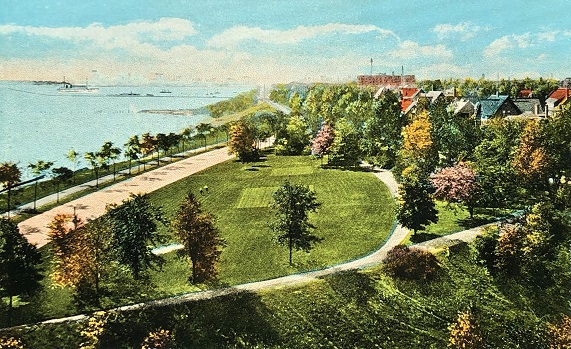
Vintage postcard: Lake Park and harbor view from lighthouse, Milwaukee, Wisconsin.

Recommended reading on the craft of fiction: A Swim in a Pond in the Rain (In Which Four Russians Give a Master Class on Writing, Reading, and Life) by George Saunders, Bloomsbury Publishing, 2021

In grad school, I remember how few of my MFA cohorts would admit they had “What the heck?” reactions to some of our fiction reading assignments. They always “got it” or at least grinned enigmatically.

However, writer and professor George Saunders acknowledges that his students at Syracuse University have had what-the-heck reactions to the short stories he assigns. To elicit such honesty from students, Saunders must create a collegial space for questioning and exploration in his classrooms. His 2021 book, A Swim in a Pond in the Rain, demonstrates this mode of inquiry.

In A Swim in a Pond in the Rain, Saunders shares the assigned readings, lectures, and discussions from his popular Syracuse course that examines the short fiction of several nineteenth-century Russian authors — Anton Chekhov, Ivan Turgenev, Leo Tolstoy, and Nikolai Gogol (who had Ukrainian roots). Within his analysis, Saunders acknowledges student critiques, such as that certain specifics seem like fluff.

Saunders shows how he can take a story that makes you shrug (and consider cutting by half) and helps you see how the writer’s craft works. At least once, he challenges you (and his students) to try cutting an assigned story, which turns out to be an insurmountable task.

These types of hands-on revelations are especially useful when turned to your own writing. Your awareness of what is and isn’t working in your own drafts grows after seeing these Russian stories through Saunders’s lens, alongside student and critical perspectives.    

One of the many concepts that will stick with me from this book is TICHN. “As we read a story (let’s imagine) we’re dragging along a cart labeled ‘Things I Couldn’t Help Noticing’ (TICHN),” Saunders writes.  Language choices, story structure, patterns, and so on — noted consciously (or not) — may fill the TICHN cart. For readers, the TICHN cart may offer aha! moments upon reflection. For writers, these elements may help bring together a story’s ending.

A Swim in a Pond in the Rain starts by approaching a Chekhov story one digestible page at a time: page, discussion, page, discussion, and so on. The book continues with newer translations of the Russian short stories, with each story examined further in “Afterthoughts.” At times, Saunders offers discussions of discussions that break down the stories through outlines, editing challenges, and exercises for students.

It’s no secret that I would recommend A Swim in a Pond in the Rain. As readers, this book helps us see how some notable fiction works. As writers, we can apply the knowledge and techniques revealed to our own fiction. As teachers or workshop participants, Saunders offers approaches and hands-on tasks to use in the classroom and beyond.