Halloween Story Confections

Vintage: Mystic Tray from Haskelite Manufacturing of Chicago.

5 podcasts & online readings for going scarily into the night

It all started with “Goblin Market” by Christina Rossetti, or rather podcaster Jacke Wilson’s reading and discussion of “Goblin Market” on his History of Literature Podcast. Although the episode was available months earlier, I didn’t get to it until last October, and it was perfect for Halloween.

As the autumn holidays approach, I’m looking for more Halloween podcast goodness — a healthier pastime than, say, a trip to the candy stash that’s supposed to be for the trick-or-treaters.

Here’s some of what I found (or returned to):

1.      “Goblin Market”

Already mentioned… Episode 415 “Goblin Market” by Christina Rossetti on the History of Literature podcast. Rossetti’s extended narrative poem follows “two sisters seduced by the fruits being sold by a pack of river goblins,” writes Wilson.  

  • See the Poetry Foundation’s website for the full text of Rossetti’s “Goblin Market” from Goblin Market and other Poems, originally published in 1862.

2.      “The Tell-Tale Heart”

The Tell-Tale Heart” by Edgar Allan Poe – History of Literature’s episode 450. The classic dark tale benefits from Wilson’s discussion of Poe’s life and the story’s oh-so-telling details.

  • See the Poe Museum’s (Richmond, VA) website for full text of “The Tell-Tale Heart,” which was first published in 1843. 

3.      “Spooky Stuff! Halloween Romance”

Spooky Stuff! Halloween Romance Interstitial” – For romance novel fans, this episode from the fifth season of the Fated Mates Podcast recommends “some of our favorite recent witches and demons and incubii and ghosts and vampires and others,” write hosts Sarah MacLean and Jen Prokop. The hosts also “try to get to the bottom of why paranormal romance and monster romance [don’t] feel like Halloween romance.” NOTE: Adult themes, NSFW, headphones recommended, etc.     

4.      Apex Magazine

Apex Magazine’s Episode 99 featuring “Over Moonlit Clouds” – For dark speculative fiction, including this lycanthropic/aviation/societal dilemma by Coda Audeguy-Pegon, check out Apex Magazine, which posts narrated versions of its stories regularly.

5.      Ouija Board insights

Ouija Board: What We Ask of the Dead – For the nonfiction minded, this essay by Kaia Preus from Arizona State University’s Superstition Review offers some contemporary perspectives and history on Ouija Boards.

Return to these podcasts and publications for recent offerings about, say, “The Legend of Sleepy Hollow,” “devils” in the romance genre, or just more of the “Strange. Surreal. Shocking. Beautiful.”

Related Post: Candy holidays, Pynchon’s “Marmalade Surprises,” and a writing prompt
Play with your words: Poetry craft, reading & revision

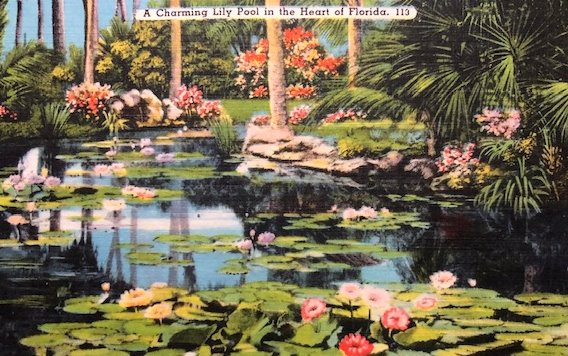
Postcard Florida lily pond 19_0924b - Copy

Vintage postcard: A charming lily pool in the heart of Florida

When I was in grad school a few of the poetry students seemed to be more, er, playful. I remember a potluck dinner at a professor’s house where one of the poetry contributions was an 8½-by-11-inch pan of Jell-O with mini bottles of booze gelled into it. The liquor was plucked out and consumed. The blue gelatin, not so much.

Outside of parties, there seemed to be little overlap between students and faculty in the poetry track and those in the fiction track. In hindsight, I wish my program had required us to take workshops and literature classes in other genres. For me, the magical realism class taught by Alberto Ríos offered the most in terms of genre blending with topics ranging from Dadaist poetry and images to novels by Isabel Allende and others.

Post-MFA I felt ill-prepared when my first teaching gig included a creative writing class meant to cover both fiction and poetry. I had much more to offer students in the fiction unit. For the poetry segments of the course, I relied heavily on the textbook.

Reading about poetry

Through the years I worked to make up for this gap in both my reading and my work in poetry. A few books I return to time and again are:

  • Poet’s Choice by Edward Hirsch. The book collects his columns from Washington Post Book World and covers an array of poets and poetry styles. The individual columns offer platforms for further reading, “from ancient times to the present,” and for drafting.
  • The Poet’s Companion: A Guide to the Pleasures of Writing Poetry by Kim Addonizio and Dorianne Laux. With sections on “Subjects for Writing,” “The Poet’s Craft,” and “Twenty-minute Writing Exercises,” this book is geared for classes or self-study. Wondering how to structure a sestina or how to address death and grief in poetry? This book can help.
  • The Poetry Home Repair Manual by Ted Kooser. This book is subtitled “Practical Advice for Beginning Poets,” and that’s what it was for me. This book helped me play with words and possibilities, even when I was writing about heavy topics.

Reading poetry itself

One of the usual prescriptions for writers is to read. Kooser’s book led me to subscribe to his column and others like it. Daily and weekly poems pop into my inbox from sources including:

  • American Life in Poetry—Kooser, a former U.S. poet laureate, sends out a weekly poetry column. Each column includes his introduction to the poem and some basics about the author of the week’s poem. Access the columns online at americanlifeinpoetry.org or subscribe (free) to receive the week’s poem in your inbox. The column’s supporters include The Poetry Foundation.
  • Poem-a-Day—The Academy of American Poets offers, both on their website or via free email subscription, a variety of poetry that includes pieces by contemporary writers, works in progress, and samples of centuries-old verse. Each Poem-a-Day email has a statement from the poet about the genesis of their work or a historical note, as well as a brief author bio.

Any of these inbox poems can lead to deeper dives into the poetry of individual writers. Reading a whole book from a particular poet can help you connect to their work in a way that a single poem often cannot.

NOTE: Content on the Poetry Foundation and the Academy of American Poets websites also cover the craft of poetry and are a useful accompaniment to the books mentioned earlier.

Seeing revision in progress

Another helpful area of reading has focused on revision. One book in particular made me feel like I’d observed a college poetry workshop in that it took student-level poems and offered critiques from an array of teacher/poets:

  • Poets Teaching: The Creative Process edited by Alberta T. Turner. This is an older book, published in 1980, that I rescued from a bin headed to the college Dumpsters. (Who knew that indexing books in online databases costs more than keeping the books on the library shelves? But that’s a matter for another day.) This book advanced my understanding of line, exposition, sound, and so much more.

Each student poem in the book received extensive comments (sometimes contradictory) from two or more of the thirty-plus teachers, among them David St. John, William Stafford, and Thomas Lux. Occasionally, the teachers offered line-level suggestions for the more advanced poems to show how handling lines in different ways led to different effects.

Some feedback in this book made me shudder. Individual teachers didn’t hold back from labeling writing as “boring.” One even said, “it may turn out her abilities do not lie in writing, but in some other direction entirely.” Yikes! Is this any indication of what goes on in college-level poetry workshops? Or is it just a few of these teacher/poets?

Play with your words

Beyond reading poetry, craft, and revision texts, I’ve learned you should play with your words. Let yourself do the writing equivalent of chilling mini-bar liquor bottles in a tray of blue Jell-O. You can always pluck them out, throw them out, consume them, or turn them (or the Jell-O) into something else entirely in the next draft.