3 Resources to help writers get back on track: Motivation (lack thereof)

Vintage postcard: Forest Drive, Near Observatory Tower, Peninsula State Park, Door County, Wisconsin.

For some reason, meeting writing goals and finishing projects seem more difficult these days.

What’s getting in the way of your writing?

  • Is it the specter of AI replacing you as a writer? Or fears that AI could copy, replicate, and surpass your writing, as has happened to some visual artists?
  • How about the publications (markets) you’ve been watching that closed to submissions while they figure out how to handle all the AI-generated stuff?
  • Is it the revelations about contests/lit mags/publishers that continue to accept submissions (and fees) but never publish anything or much of anything?  
  • Have you received just one rejection too many?
  • Is it that life is getting back to normal, and suddenly there’s so much to do (besides writing) now that lockdowns are in the rearview?
  • Is it just summer?
  • Is it just me?

Setting writing goals, seeking inspiration, and addressing common frustrations seem to help. Or at least they sound good. Here are a few resources for writers:

1.      1000 Words of Summer

In her Poets & Writers Magazine article, “1000 Words of Summer: How an Accountability Project Opened Up My Writing Life,” Jami Attenberg discusses how a now-worldwide project started, “In 2018 my friend Anne Gisleson and I decided to write a thousand words a day, every day, for two weeks straight.” The #1000wordsofsummer project’s sixth year started on June 17, 2023, and Attenberg has been posting daily on her Craft Talk newsletter, as well as on Instagram and Twitter. Even if you’re starting this project late, there’s still time to read the newsletters and get a writerly boost.  

2.      Field Trips for Serendipity & Inspiration

Maybe you feel like you don’t have time to peruse a book or take a field trip, but maybe you’ll find information you need (a key, an inspiration) from an unexpected source. What book or artwork or object practically jumps out at you? Here are a few places that might coax creativity your way:

  • The recent releases shelf at your local library. What catches your eye? How might a source connect to your works in progress?
  • Museums, galleries, resale shops, flea markets, and more. Again, what are you drawn to? Ask yourself what the visuals, objects, and their histories could contribute to your writing. Maybe do some people watching too. For instance, I once saw a goateed woman haggling with a burly vendor over sewing notions at a swap meet.
  • Immersion in tastes, smells, and sounds. Indulge your senses at spice shops, confectionaries, farmer’s markets, ethnic restaurants, neighborhood sporting events, music recitals, and more. Sometimes just listening to buildings—the different sounds inside a high-rise and a hospital—can alert you to telling details for your writing.   

3.      Websites for Writers

Moderation (avoiding rabbit holes) is important, especially with websites, but sometimes hearing what other writers are saying is reassuring:

  • Writer Unboxed: This website “is dedicated to publishing empowering, positive, and provocative ideas about the craft and business of fiction… [T]he site now hosts more than 50 contributors, including bestselling and rising authors and industry professionals.”
  • Writer’s Digest’s 101 Best Websites for Writers: Past categories have included: Best Live Streams, Podcasts, and YouTube Channels for writers; Best Writing Advice Websites (including Writer Unboxed); and Best Genre/Niche Websites. The 2022 list came out in July, so the 2023 listings should be published soon.

In the end, doing something (anything short of a bonfire) with your writing is more productive than the alternative, right?

Related Post: Distractions: Don’t let Mr. Facebook and Ms. Phone keep you from your writing projects
3 blogs that flog, deconstruct or explain the choices fiction writers and editors make

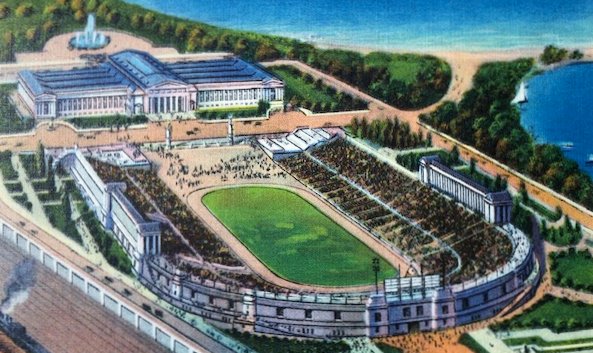
Vintage postcard: Soldiers Field & Field Museum at the Chicago lakefront.

Miss those fiction workshop critiques of other writers’ work? Maybe? I remember having a lot of time to doodle in MFA workshops, especially when the conversations turned contentious. Then, moments of constructive feedback would connect to my own writing and lead to furious notetaking.

Reminiscent of the best graduate school critique sessions, the following three blog series offer insights into the craft of fiction writing. We have the added knowledge that whatever worked (or not) in the stories has resulted in publication.

Flog a Pro: Would You Pay to Turn the Page of This Bestseller?

In monthly posts on Writer Unboxed, Ray Rhamey provides a novel’s first 17 lines and asks “Would you pay good money to read the rest of the chapter?” And, by extension, would you be willing to risk money and time to read the book, especially if you were a busy literary agent?

After the novel’s opening lines, Rhamey shares his verdict, explains his reasoning, and polls blog readers for their verdicts and comments. Reader comments, along with Rhamey’s own, offer useful perspectives into storytelling choices and their consequences. The series has examined books by Elin Hilderbrand, Kristin Hannah, Stephen King, and John Grisham, among others. The outcomes can be surprising, especially when the writing of a well-known novelist doesn’t conform to commonly held writing advice. (Note: The opening of Stephen King’s most recent novel didn’t fare as well as you might think.)

Ray Rhamey offers the opportunity for writers to receive similar feedback on their works in progress through his Flogging the Quill blog. Rhamey is the author of five nonfiction books, including Mastering the Craft of Compelling Storytelling, and four novels in genres such as political thrillers and contemporary fantasy.

Let’s Deconstruct a Story

“Let’s Deconstruct a Story: A Podcast for the Story Nerds” is a series of podcasts and blog posts that include author interviews conducted by Kelly Fordon, who teaches writing in the Detroit area and has published two short story collections and a poetry collection.

August’s post featured an interview with Susan Perabo about her story “This Is Not That Story,” which appeared in The Sun in March 2006. Perabo, whose most recent book is They Run the Way They Do, ended the interview by saying, “I love getting into the choices and the questions that only deep reading and deep thinking can get you to. I think you’re doing a great service for writers and for students of writing, and that’s all of us, right?” 

As with all critique sessions, you should read the story first, and Fordon provides links to the texts under discussion. Her posts often go beyond the basics. For example, in a deconstruction of the story “Creve Coeur” by Jacob M. Appel, Fordon created a word cloud from the adjectives Appel used. It’s telling that the words “dark” and gray” stand out, as do the words “indifferent” and “happy.”

NOTE: Beyond deconstructing someone else’s story, creating a word cloud for your own work can be a useful editing and revision tool for exploring a story’s tone and the ideas or themes being explored.

“I’m basically offering these workshops on ‘Let’s Deconstruct a Story’ for my own gratification because I feel like I learn so much from studying the stories of other writers,” says Fordon at the beginning of her work with Appel’s short story. “Really delving into them. Seeing how they work, the mechanics, so I can get some more tools for my own toolbox.”

(Thank you to Erika Dreifus and her “Practicing Writer” blog for bringing Kelly Fordon’s work to my attention.)

Why We Chose It

The Kenyon Review’s blog includes the occasional feature “Why We Chose It” written by the literary magazine’s fiction and nonfiction editors. Posts in the series link to a current selection from the Kenyon Review so that you can read the text being discussed. For veterans of lit-mag rejections, the posts offer insight into what drew an editor to a particular story.

In a recent “Why We Chose It” post, the Kenyon Review’s Sergei Lobanov-Rostovsky focuses on the short story “Caduceus” by Perry Lopez, which appeared in the magazine’s July/August 2021 issue. Kenyon Review is published six times a year at Kenyon College in Gambier, Ohio.